
Cloudflare AI Search Launches Into General Availability
Cloudflare has officially announced that AI Search is generally available, bringing expanded multimodal features, larger file support, and upcoming billing structures.
 Radwan AbdulhadiEditor and technology writer

General Availability and Platform Architecture
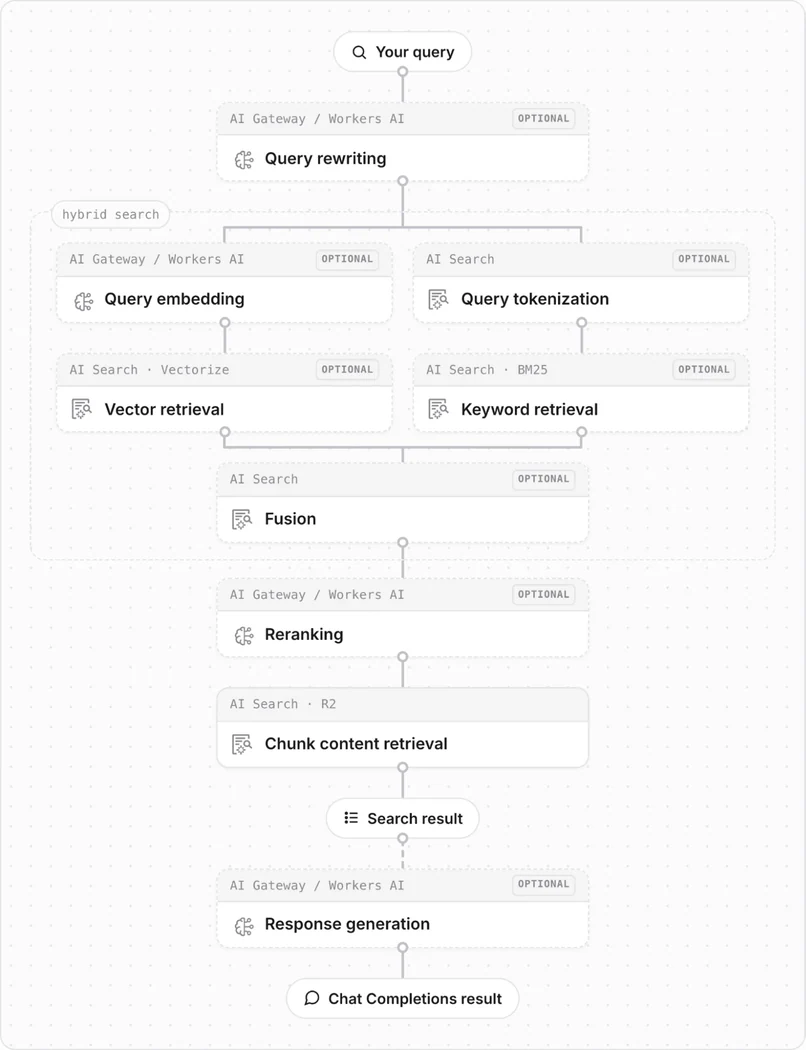
Cloudflare's AI Search has officially transitioned to general availability, following more than a year of developer use across various website and internal documentation search tasks. The system integrates Workers AI, Vectorize, R2, and Browser Run to provide a fully managed index and retrieval pipeline. Developers looking to implement or expand their search features can consult the comprehensive AI Search developer docs for technical guidelines and setup instructions.
Alongside this milestone, Cloudflare announced that billing for the service will commence on November 1, 2026. The platform will continue to offer a generous free tier across all Workers plans, giving smaller projects access to a specific monthly allotment of queries and ingestion tokens without upfront capacity units or monthly minimums.

Multimodal Capabilities and Native Image Embeddings
A primary focus of the general availability release is the expansion of multimodal formats beyond text. Previous implementations relied heavily on object detection and captions to index images. The updated platform now preserves both signals by utilizing direct image embeddings alongside text captions.
Native multimodal retrieval is powered by the Qwen3-VL-Embedding model, placing query images and indexed elements into the same vector space. To manage storage and maintain search speed efficiently, the architecture incorporates Matryoshka Representation Learning (MRL), allowing smaller embeddings to retain useful analytical information.
Even for text-only embedding models, users retain basic multimodal querying capabilities. AI Search automatically converts query images into text using ToMarkdown, allowing every model to handle visual inquiries while native models capture deeper visual characteristics.
Expanded File Support and Optical Character Recognition
In addition to visual retrieval enhancements, AI Search has expanded its input limits. The platform now accepts text files—such as Markdown, HTML, CSV, and JSON—and PDFs up to 10 MiB, marking an increase from the previous 4 MiB restriction.
Because many PDF documents are scanned images lacking extractable text, developers can turn on OCR to automatically read text from each page prior to chunking and embedding. OCR is accessible to every account and is billed under the official AI Search pricing structure as image processing ingestion tokens.
Pricing Structure and Ingestion Model
Following preview discussions during August 2026 Agents Week, Cloudflare has detailed the billing mechanics for AI Search. Costs are organized around three primary metrics: content ingested, data stored, and queries executed. Intermediate procedures like parsing, chunking, and keyword indexing are included without requiring upfront capacity unit planning.
The free monthly allotment has been adjusted to provide 1,000 semantic queries and 1,000 full-text queries as distinct pools. Detailed outlines regarding token counting, storage calculations, and tier limits are available via the official AI Search pricing documentation.

Future Roadmap and Outlook
Cloudflare indicated that multimodal embeddings represent only an initial step for the search infrastructure. Upcoming updates will introduce ingestion pipelines designed to support full video and audio processing, allowing customers to search across richer media assets.
Development teams are also refactoring the keyword search engine to scale effectively with larger datasets and building simplified index creation tools for websites running on Cloudflare. Further details on these upcoming features can be found directly on the Cloudflare Blog.
Sources
- Cloudflare BlogAI Search is now generally available