
Hcompany Introduces Holo4 Generalist Computer-Use Agents
The new series includes a 27B dense model and a 35B-A3B Mixture of Experts model, capable of interacting across diverse software interfaces.
 Radwan AbdulhadiEditor and technology writer
Overview of the Holo4 Model Series
Hcompany has officially introduced its latest series of agentic models, titled Holo4, designed specifically to operate as generalist computer-use agents. According to the release details on the <a href="https://huggingface.co/blog/Hcompany/holo4">Hugging Face Blog</a>, the new series is made available in two distinct sizes: a 27B dense model and a 35B-A3B Mixture of Experts model. Both configurations are currently accessible through the H Models API for developers and enterprises looking to integrate advanced task automation into their daily digital workflows.
Unlike many preceding artificial intelligence architectures that restrict their operations to isolated digital environments, Holo4 was engineered to handle real business operations. The development team at <a href="https://huggingface.co/Hcompany">Hcompany</a> focused on building models that can seamlessly navigate multi-step professional tasks across disparate software platforms without requiring separate model selections for different platforms.
Multi-Interface Interaction Capabilities
A defining characteristic of the Holo4 model family is its flexibility regarding software interfaces. While traditional agentic models are often trained for a single interface—such as graphical user interfaces or tool calling exclusively—Holo4 can click and type on a screen, write and run its own code, and invoke Model Context Protocol (MCP) or standard API tools based on what best fits the specific task at hand.
This cross-interface capability mirrors how humans actually work in professional environments, where a single objective might require checking a web application, querying a database through an API, and adjusting desktop software simultaneously. Holo4 runs consistently across desktops, web browsers, Android systems, code sandboxes, and business APIs, operating as the exact same model regardless of the deployment target.
Training Infrastructure and Agentic Task Factory
To achieve robust performance across complex software tools, Holo4 was trained using a combination of supervised learning and reinforcement learning. The training regimen utilized a massive repository of environments and tasks generated internally by the company's Agentic Task Factory, which produces interactive environments and verifiable tasks derived directly from documentation, screenshots of real websites, and open-source software repositories.
To date, this internal pipeline has yielded approximately 10,000 distinct tasks encompassing web applications, MCP servers, and desktop environments. These include hybrid setups that expose identical states through both a graphical user interface and an MCP server, ensuring the agent learns to choose the most efficient interaction method.
Benchmark Performance and Efficiency
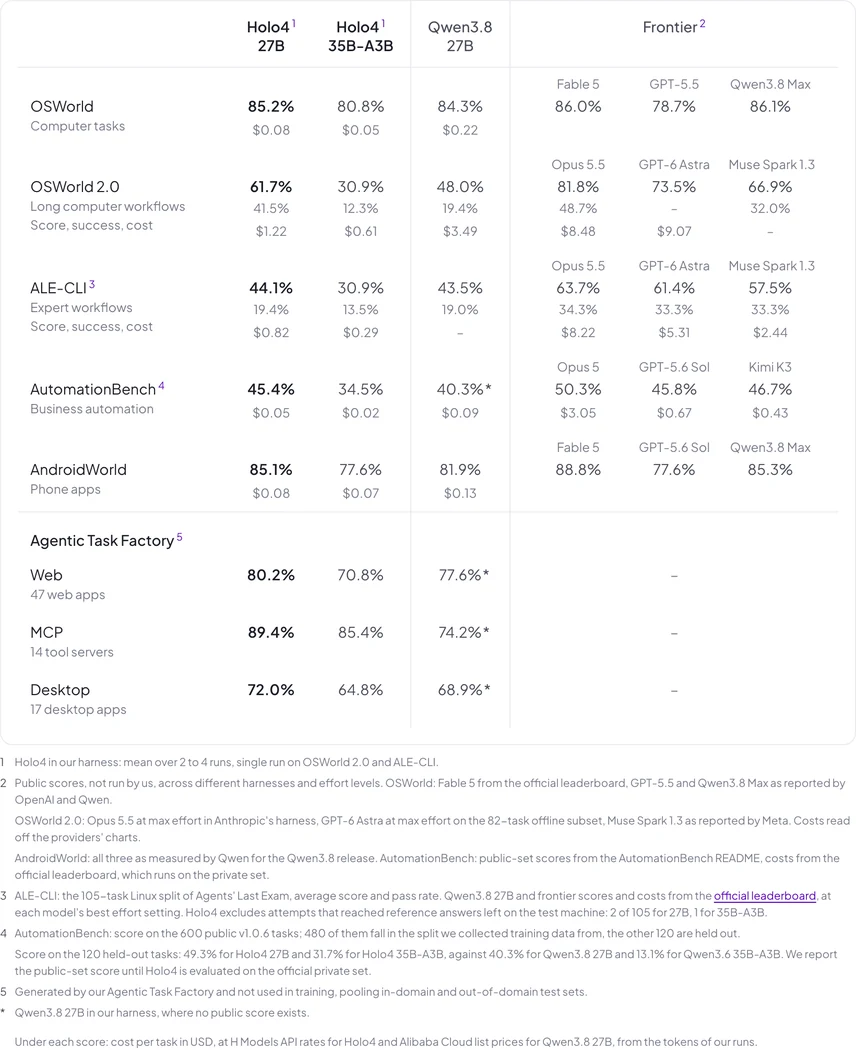
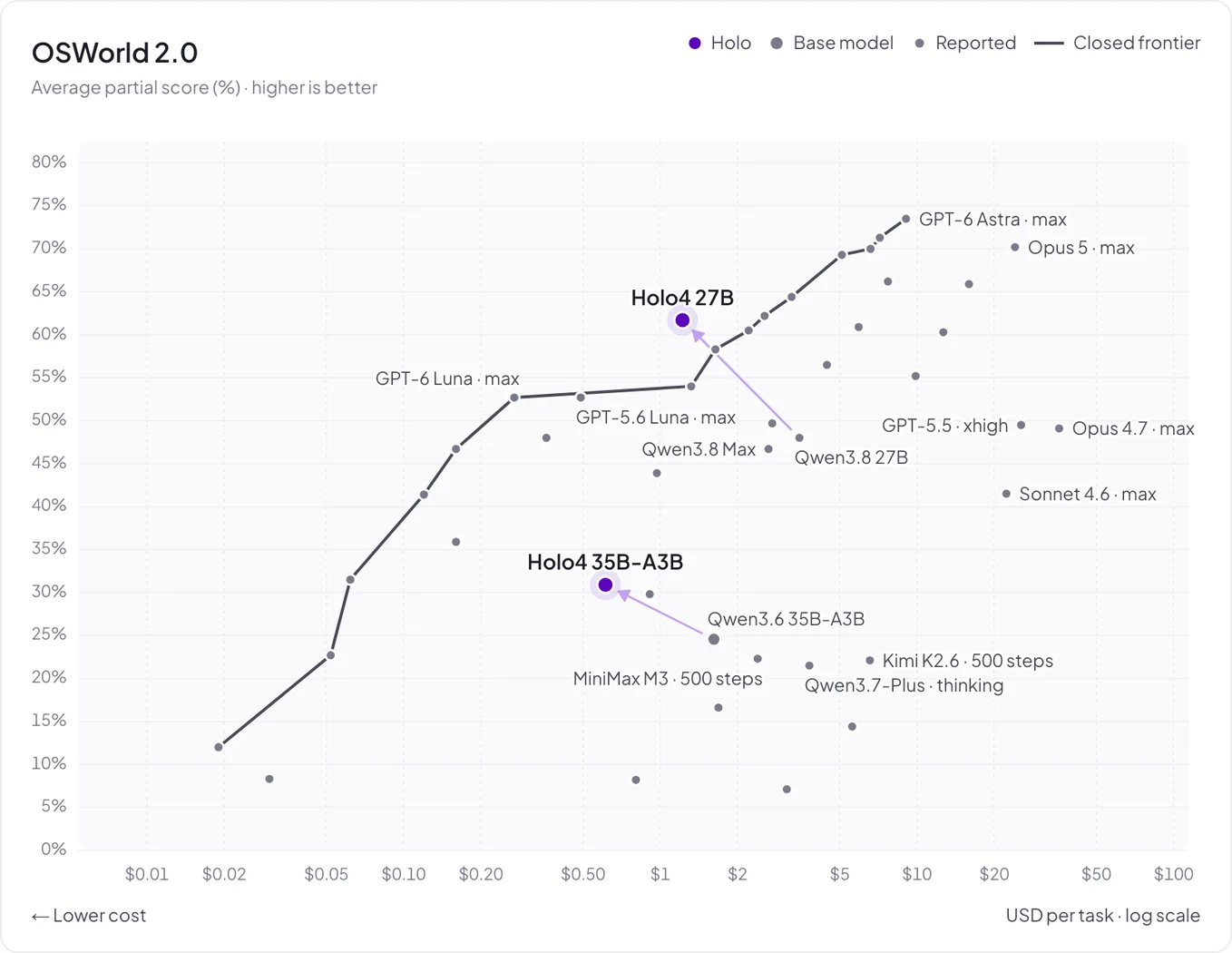
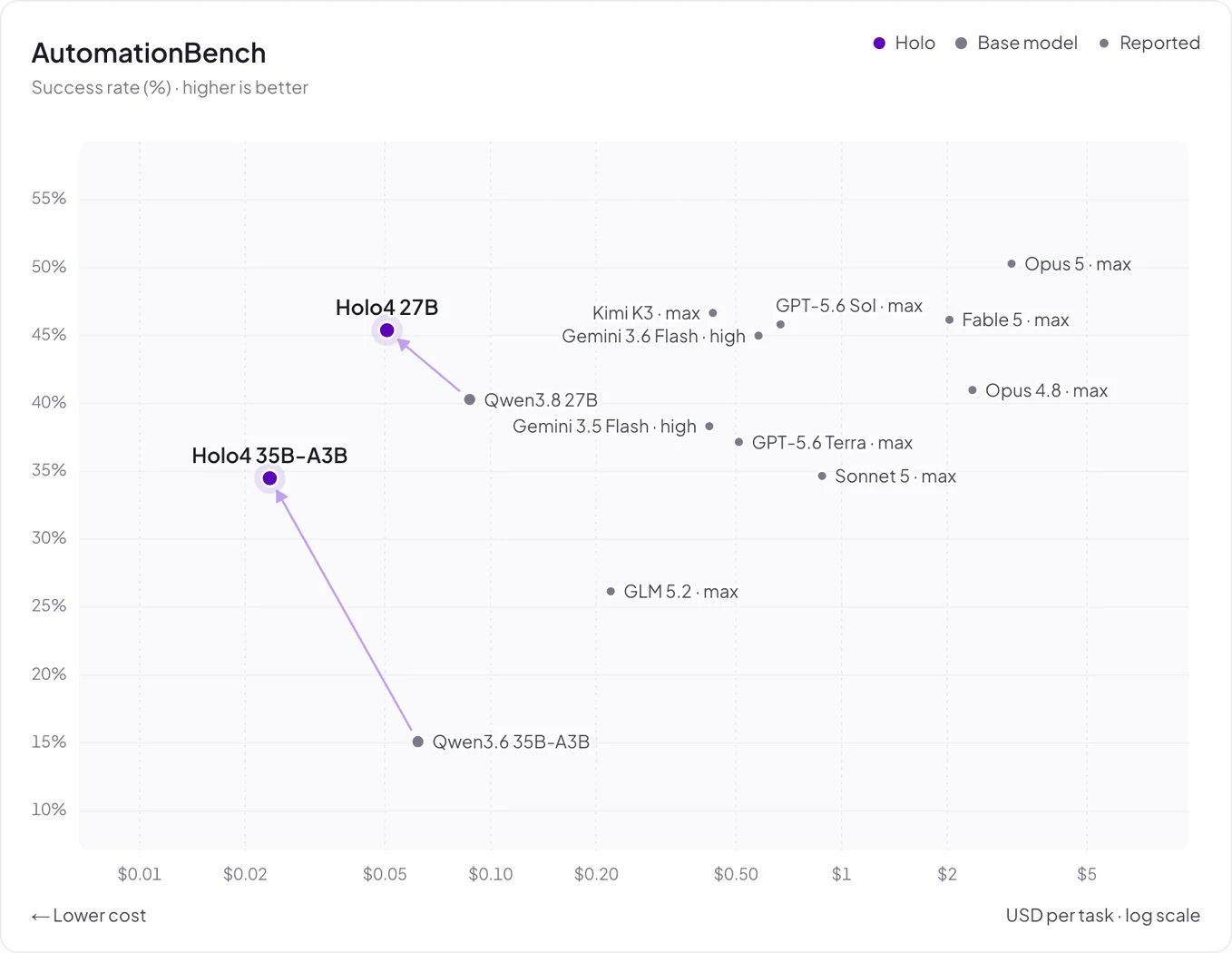
Hcompany reports that Holo4 models offer substantial improvements over their Qwen foundational base. When evaluated on demanding academic benchmarks like OSWorld 2.0 for desktop control and AutomationBench for API usage, the models demonstrate competitive capabilities against leading frontier models at a significantly lower operational cost per task.
On the OSWorld 2.0 benchmark for long workflows, the Holo4 27B model achieved a score of 61.7%, while the 35B-A3B variant reached 30.9%. Although trailing the highest-scoring proprietary systems on raw metrics, Hcompany emphasizes that its open models achieve these performance tiers with drastically fewer parameters and reduced token expenditures. Furthermore, the organization has made all evaluation trajectories publicly accessible for independent verification and replay.
Harness Improvements and Memory Management
Alongside the rollout of the new models, the engineering team completely rebuilt their execution harness—the software loop responsible for managing model actions and context windows across hundreds of steps. This redesign incorporated systematic performance feedback gathered from testing on OSWorld 2.0, where failure points were tagged and reviewed by engineers.
The most impactful modifications introduced to the harness include a reliable memory mechanism capable of tracking hundreds of sequential steps and an integrated desktop shell. These additions allow the models to maintain context over prolonged operational cycles without losing track of intermediate objectives.
Expansion with Holotron4 Nano
Expanding beyond the primary Holo4 family, the company also released an updated version designated Holotron4 Nano. Built as a continuation of their post-training methodologies, this release adapts their modular stack to new foundation architectures.
As a participating member of the NVIDIA Nemotron Coalition, Hcompany applied its latest post-training framework to the Nemotron 3 Nano Omni model, successfully converting it into Holotron4 Nano using the exact same adaptation recipe that powers the broader ecosystem.
Sources
- Hugging Face BlogHolo4: powering generalist computer-use agents