Google's TPUs Run AI Workloads in Meta's Data Centers
Google's custom AI tensor processing units are now running AI workloads in production at Meta through newly introduced open-source engines that natively support the PyTorch framework.
 Radwan AbdulhadiEditor and technology writer

Google TPUs Live in Production at Meta
Google’s custom AI tensor processing units are now actively serving AI workloads in production environments at Meta, following a cooperative development effort involving Google, Meta, and the SGLang team. The development was detailed in a report by [Tom's Hardware](https://www.tomshardware.com/tech-industry/artificial-intelligence/googles-tpus-for-ai-workloads-now-run-in-at-metas-data-centers-tpus-sold-to-external-customers-for-the-first-time-threaten-nvidias-market-dominance).
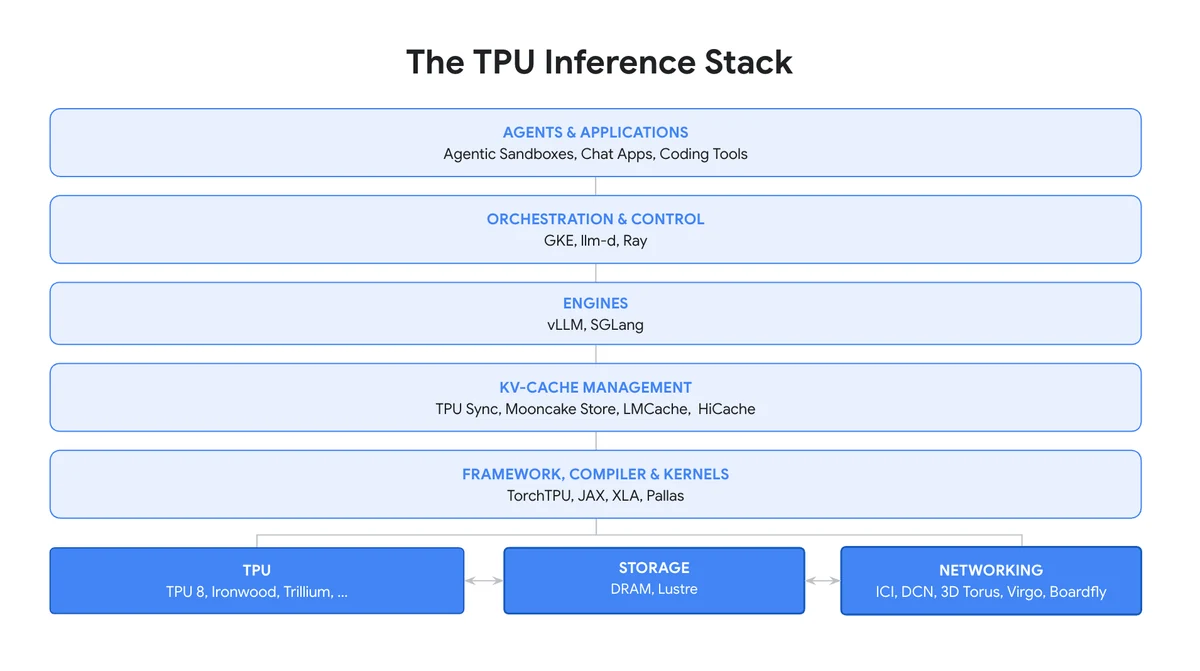
The deployment relies on a new PyTorch-native version of the SGLang inference engine, which was officially [announced on Google’s developer blog](https://developers.googleblog.com/announcing-new-vllm-and-sglang-inference-engines-on-tpu/). Alongside SGLang, a matching open-source version of vLLM was introduced to support TPU hardware natively.
Native PyTorch Support Replaces JAX Requirement
Previously, both inference engines utilized Google's proprietary JAX AI framework to operate on TPU infrastructure. The newly launched software stack enables hardware to function as a native option for PyTorch workflows, eliminating the need for extensive code rewrites.
Zongwei Zhou, Meta’s PyTorch-TPU lead, confirmed that the SGLang-TorchTPU integration is already active in production. Zhou noted that the collaborative work delivered a mature, PyTorch-native serving stack. Jana van Greunen, director of PyTorch engineering at Meta, stated that the company cannot be constrained by a single hardware architecture and that TorchTPU successfully facilitates the deployment of Meta's PyTorch workloads onto Google TPUs.
Historical Context and Previous Trials
This integration follows earlier efforts by Meta to incorporate Google hardware. Google describes PyTorch/XLA—an older bridge connecting PyTorch to TPUs—as a predecessor to the current TorchTPU architecture. Reports indicate that Meta research teams previously employed TPUs via this bridge between 2020 and 2023 before those specific agreements concluded.
Subsequent discussions between the companies reportedly centered on cloud TPU rentals and procurement schedules. Industry observers note that these hardware deployments and software updates arrive as major technology firms work to bypass software lock-in associated with dominant architectures.
Broader Industry Shifts and Performance Metrics
The announcement coincided with a similar move from Amazon, which revealed plans to open-source TorchNeuron—its native PyTorch backend designed for Trainium2 and Trainium3 chips—at the PyTorch Conference. Both ecosystem updates are widely viewed as efforts to challenge existing market dominance in accelerated computing.
Regarding performance benchmarks, a tuned vLLM configuration operating on the seventh-generation Ironwood TPU achieved high token speeds when serving Moonshot AI’s large language models. Developers involved in the testing reported significant throughput gains at small batch sizes compared to baseline setups on alternative multi-chip hardware configurations.
Future Expansion and Roadmap
The development teams plan to expand SGLang-TorchTPU compatibility to encompass additional models, starting with DeepSeek V4.1 Flash and Reflection Beam. Furthermore, RadixArk indicated an objective to establish Day 0 TPU support for newly released open models by the first quarter of 2027.
Additional technical details regarding these open-source inference engines and production deployments are scheduled for presentation at the upcoming SGLang Summit in San Francisco.
Sources
- Tom's HardwareGoogle’s TPUs for AI workloads now run in Meta's data centers
Continue chronologically

Related entity coverage
Related stories
Google Joins Amazon in Challenge to Nvidia's AI Lead
Google has released its open-source TorchTPU tool, allowing PyTorch developers to easily move their applications off Nvidia GPUs and onto Google Cloud.

Senate Investigation Alleges AI Data Center Claims Mislead Public
A U.S. Senate investigation accuses AI data center developers of misleading the public regarding community costs, permanent jobs, and tax benefits.

Websites Move to Block Autonomous AI Agents
Major websites, airlines, and financial institutions are blocking AI agents from OpenAI, Meta, and Google, undermining their utility.
French Lawmakers Approve Internet Tax on Data Traffic
French lawmakers have approved an amendment for a data traffic tax on digital content providers, targeting major tech giants like Google and Meta.