AWS Updates Fleet Computer Vision Pipeline With SageMaker SDK v3
A newly updated reference architecture leverages Amazon SageMaker SDK v3 and Amazon SageMaker Neo to automate training, evaluation, and edge compilation for thousands of individual plant cameras.
 Radwan AbdulhadiEditor and technology writer
Scaling Fleet-Wide Computer Vision at the Edge
Managing computer vision model lifecycles across an industrial fleet presents distinct hurdles once a proof of concept moves into full production. While a single model works well for one controlled camera, deploying that same setup across multiple manufacturing lines reveals that every camera captures a unique environment. Variations in viewing angles, reflections off stainless steel surfaces, and shifting ambient light mean that pooled training data often underperforms compared to individual, fine-tuned models.
To address the complex challenge of training, evaluating, versioning, and shipping thousands of distinct camera models without manual intervention, a newly published reference architecture updates previous MLOps deployment patterns. Utilizing modern tooling available through <a href="https://aws.amazon.com/sagemaker/">Amazon SageMaker</a>, engineering teams can now automate the entire lifecycle of per-camera computer vision models while keeping operational costs remarkably low.
Dual-Branch Pipelines and Edge Optimization
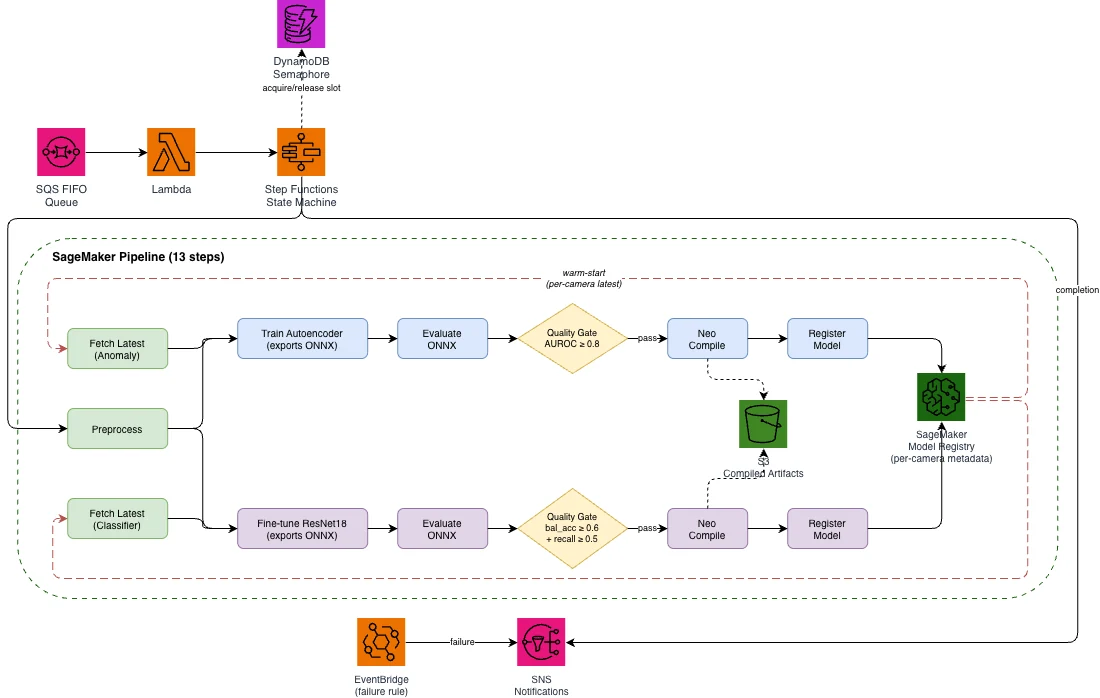
The updated architecture implements a dual-branch Amazon SageMaker Pipeline parameterized by camera ID, running thirteen distinct steps per execution. Three parallel entry steps preprocess incoming images, fetch the latest anomaly model, and retrieve the latest classifier model. The system then trains a small convolutional autoencoder to flag anomalies via reconstruction error alongside a fine-tuned ResNet18 classifier designed to confirm product defects.
Following rigorous evaluation against held-out data and strict quality gates, approved models are compiled directly using <a href="https://docs.aws.amazon.com/sagemaker/latest/dg/neo.html">SageMaker Neo</a>. This compilation step transforms portable ONNX artifacts into device-optimized shared libraries loaded by the DLR runtime. Developers can inspect the complete reference implementation and automation scripts directly within the <a href="https://github.com/aws-samples/sample-sagemaker-fleet-cv-pipeline">aws-samples GitHub repository</a> to understand the full pipeline mechanics.
Orchestrating Fleet-Scale Retraining
Running thousands of simultaneous training jobs can easily overwhelm standard cloud account quotas. To solve this, the orchestration layer relies on an Amazon Simple Queue Service FIFO queue paired with an AWS Lambda function that triggers individual Step Functions executions. Each execution must acquire a concurrency slot through a DynamoDB semaphore before launching its pipeline, ensuring that sudden bursts of retraining requests drain at a predictable, controlled rate.
Operational monitoring is integrated throughout the infrastructure. Successful completions publish status updates to an Amazon Simple Notification Service topic, while operational errors are automatically routed to the same topic via an Amazon EventBridge rule that preserves error diagnostics. By maintaining strict execution ceilings, the orchestration framework keeps concurrent training workloads safely within standard account limits.
Adopting SageMaker SDK v3 Architecture
The architectural update incorporates the latest structural changes introduced in Amazon SageMaker Python SDK v3. The SDK reorganizes functionality into modular packages including sagemaker-core, sagemaker-train, sagemaker-serve, and sagemaker-mlops. Consequently, training configuration parameters that were previously passed across Estimator constructor arguments in version 2 are now encapsulated within typed configuration objects supplied directly to ModelTrainer.
Deploying the complete stack via the AWS Cloud Development Kit requires careful management of AWS Region variables across deployment commands to prevent partial synthesis mismatches. Additional information on maintaining proper execution permissions, bucket configurations, and repository resources can be found by following guidance on the official <a href="https://aws.amazon.com/blogs/machine-learning/">Artificial Intelligence</a> blog and associated repositories.
Sources
- AWS Machine Learning BlogFleet-wide computer vision lifecycle at the edge with SageMaker SDK v3
Continue chronologically
Related entity coverage
Related stories
Manage SageMaker HyperPod Spaces Directly from Studio
Data scientists and machine learning engineers can now create, configure, start, stop, and open Amazon SageMaker Spaces directly from SageMaker Studio.
AWS Launches Amazon SageMaker HyperPod Inference Gateway
Amazon introduces the SageMaker HyperPod Inference Gateway, a GPU-aware routing add-on for EKS designed to slash inference latency for LLM deployments.
AWS Introduces aws-ai-ml Skill for Coding Agents
Amazon SageMaker AI introduces the aws-ai-ml skill via Agent Toolkit for AWS, equipping coding agents like Kiro and Claude Code with inference optimization.
Share GPU Clusters Across Teams with Amazon SageMaker HyperPod
Discover a reference architecture to share a single Amazon SageMaker HyperPod EKS cluster across multiple teams with isolation and fairness.