
OpenAI Expands Academy with Role-Specific AI Learning Paths
The company has introduced a new suite of structured courses designed to help organizations and individuals transition from AI experimentation to reliable, real-world application.
 Radwan AbdulhadiEditor and technology writer
Broadening the Scope of AI Education
OpenAI has announced a significant expansion of its educational ecosystem, officially launching new learning pathways within the OpenAI Academy to support employees, developers, leaders, educators, and students. The initiative is built on the philosophy that learning to use artificial intelligence effectively requires hands-on practice, treating education as an essential component of the deployment process. By offering specialized courses, the company aims to help users move beyond general experimentation toward building reliable and useful AI-driven systems, as detailed in their latest update on the Expanding OpenAI Academy with new learning paths.
The platform functions on a practical core principle: learners should use AI to learn AI. Participants are encouraged to engage with real tasks, providing instructions, incorporating relevant context, and reviewing the outcomes. Those who successfully complete the required course assessments earn an official OpenAI Academy badge, providing a tangible way to demonstrate their newly acquired capabilities.
Workplace Skills and Technical Development
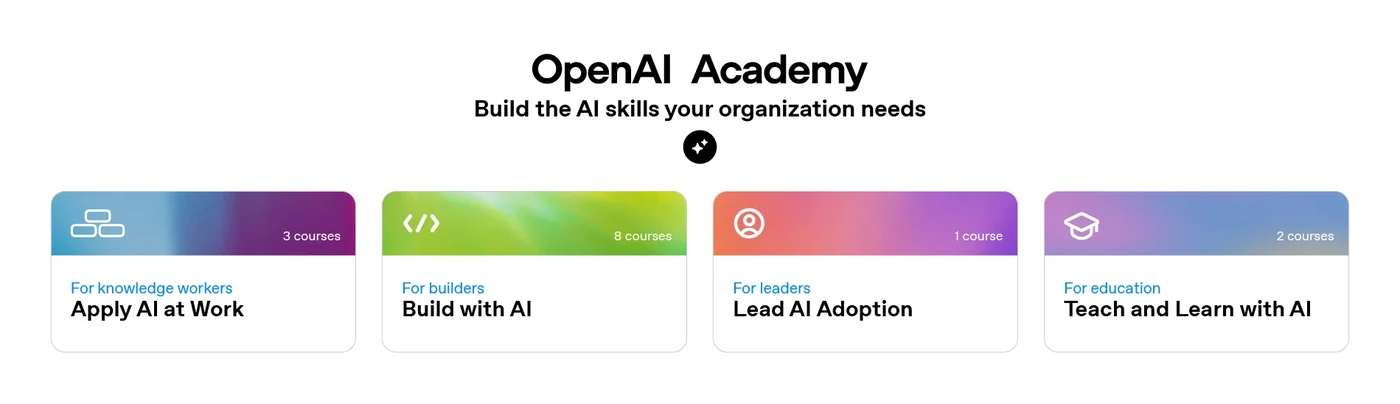
A primary component of the expanded portfolio is the Apply AI at Work pathway. This course is designed to transition individuals from basic interactions with models to the creation of repeatable, efficient workflows. Learners practice providing clear prompts, managing context, and ultimately delegating larger, complex tasks to AI agents. By integrating human review and checkpoints, the training helps employees increase their productivity while maintaining responsibility for final deliverables.
For technical teams and software developers, the company has introduced the Build with AI pathway. This curriculum focuses on the integration of Codex and the OpenAI API into existing product development cycles. The course covers critical areas such as solution design, system evaluation, and the management of AI agents. It provides developers with the framework necessary to manage software lifecycles effectively while ensuring the quality and reliability of AI systems operating in production environments.

Strategic Leadership in AI Adoption
Recognizing that successful integration requires high-level oversight, the academy now offers the AI Leadership course. This program is aimed at executives and managers responsible for driving organizational change and defining AI strategy. It helps leaders identify where AI can provide the most meaningful business value, establish clear ownership and governance, and develop a comprehensive roadmap for long-term adoption, forming a core part of the broader efforts to Lead AI Adoption.

Tailored Resources for Educators and Students
Education institutions represent a major focus of this expansion, with the inclusion of specific courses for both faculty and students. The AI for Educators program empowers teachers to use AI to streamline lesson planning, create assessments, and adapt materials for students and teaching assistants. Crucially, the training emphasizes that the educator retains final authority over what information is appropriate for their classroom instruction.
Simultaneously, the AI for College Students course focuses on practical applications that bridge the gap between academic requirements and career readiness. Students are taught to manage complex academic tasks, such as organizing study schedules, managing group project roles, and preparing for job applications or professional interviews. By learning to integrate the right materials into ChatGPT, students can refine their drafts and make informed decisions about their academic and professional outcomes.

Implementation and Continued Evolution
Organizations are encouraged to combine these various paths to create a custom curriculum that aligns with their specific goals. For instance, a firm might combine basic training for staff with technical courses for developers and leadership tracks for management. As the company continues to refine its models and products, the course content will be updated to reflect the latest guidance. For those looking to integrate these materials, resources such as AI Foundations are available to help kickstart the learning process.
Sources
- OpenAI NewsExpanding OpenAI Academy with new learning paths