Deepseek Unveils V4.1 Flash 1017 AI Model
Deepseek has released a revision to its V4.1 Flash open-weight artificial intelligence model, driving down hardware requirements and task costs while facing scrutiny over its reliability.
 Radwan AbdulhadiEditor and technology writer

Introduction to Deepseek V4.1 Flash 1017
Deepseek has upgraded its V4.1 Flash open-weight artificial intelligence model to revision 1017, introducing improvements in model efficiency and cost-per-task metrics. According to details shared on the official product page, the update carries the slogan "wish-driven programming made real," reflecting its suitability for open-ended workloads and broad descriptions akin to vibe coding. Detailed information regarding the update can be reviewed directly on the product page.
The artificial intelligence landscape is broadly split between expensive closed commercial models from frontier labs and lower-cost open-weight competitors. While commercial models often prioritize strict reliability, open-weight alternatives focus heavily on reducing running costs for long-running agentic tasks.
Architecture and Hardware Efficiency
Deepseek V4.1 Flash is a Mixture-of-Experts model featuring 552 billion total parameters, with 16 billion active during runs. The multimodal model accepts both text and images as inputs and supports a 1-million-token context window length. Performance evaluations and scoring details are frequently tracked across various industry benchmarks.
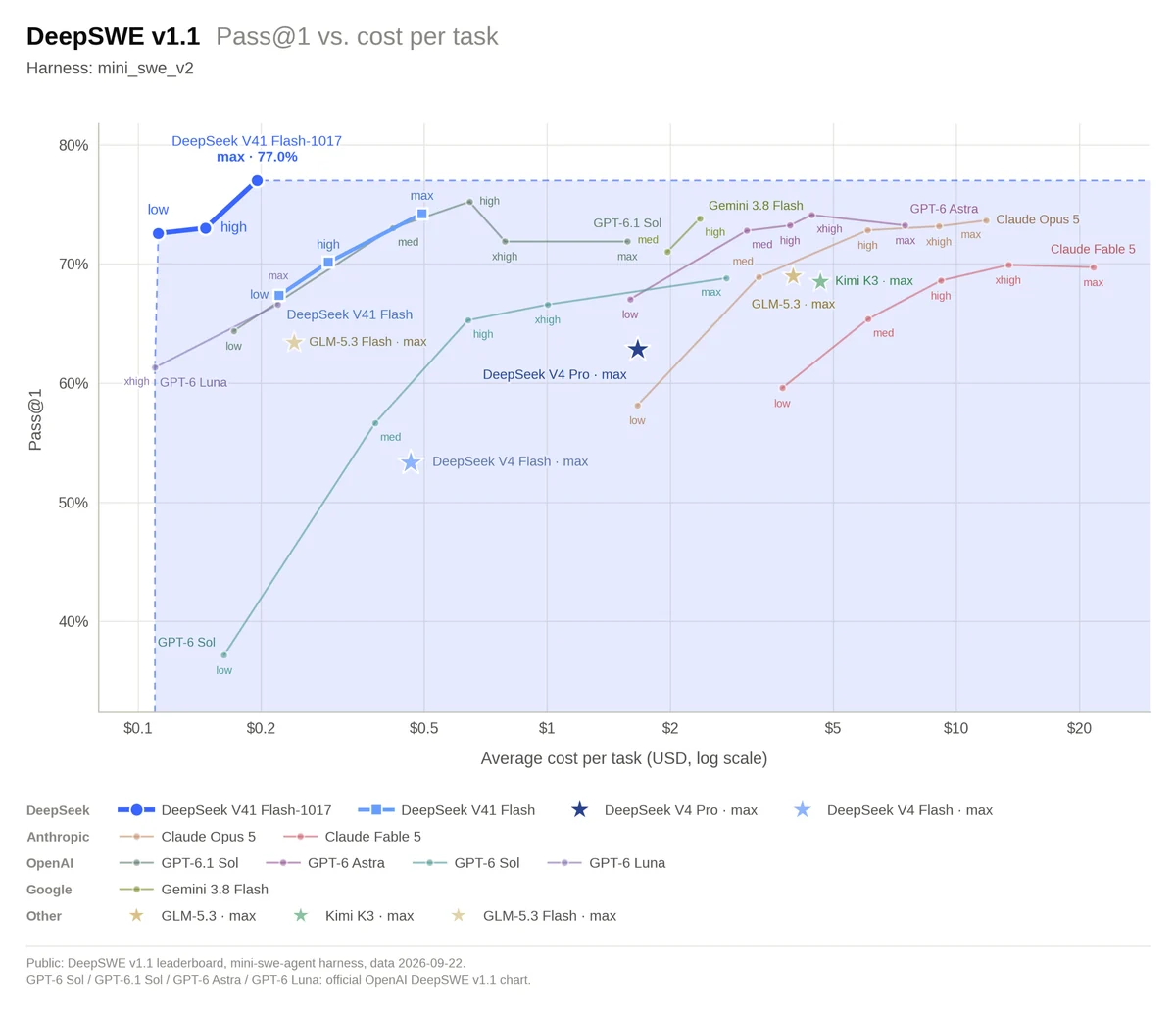
The 1017 revision significantly slashes hardware requirements compared to the previous V4 Flash iteration. Specifically, the updated model uses only one-quarter of the High Bandwidth Memory and one-eighth of the SSD storage for its KV cache, spending just 890 bytes per token entry.
Benchmark Performance and Pricing
Internal Deepseek benchmarks place the model between GPT-5.6 Sol and Claude Opus 5, even surpassing Anthropic's large language model in certain task tests. Furthermore, Artificial Analysis ranks the max variant of DSF-1017 as number two on its intelligence index within the large open-weight category, noting it as one of the fastest models in its class.
In terms of operational pricing, off-peak rates per million tokens are set at $0.15 for inputs and $0.60 for outputs, while cache hits reduce input token costs to $0.003. Additionally, Deepseek's search functionality is priced at $0.75 per 1,000 queries, undercutting competing services.
Hallucination Challenges and Reliability
Despite its competitive speed and low cost, the model faces notable hurdles regarding reliability. Artificial Analysis data indicates that DSF-1017 struggles to recognize when it lacks supporting facts, resulting in a high rate of hallucinations during open-ended queries.
The Omniscience benchmark highlights these issues, showing that the model hallucinates a significant percentage of non-answers rather than declining to answer when unsupported. Consequently, experts suggest reserving the model for tasks with verifiable outputs, such as programming and format conversions, rather than open-ended research or precise fact-checking.
Sources
- Tom's HardwareDeepseek's latest AI model is smarter than ever, but its low running costs come at a price
Continue chronologically


Related entity coverage
Related stories
Tom's Hardware Details Vera CPUs and Agentic AI Benchmarks
Explore the latest Tom's Hardware coverage including Nvidia Vera CPUs on Oracle clusters, agentic AI benchmarks, and LLM primers.

Mistral Large 4 Trails Some Chinese Open Models in Tests
Independent benchmarking ranks Mistral's new trillion-parameter Large 4 model as a top non-US and non-China AI model, though it trails certain Chinese open alternatives.

Former OpenAI Safety Lead Exits, Calling Culture Broken
David Robinson leaves OpenAI after more than three years, citing a reactive safety culture, a failed kill switch, and a July HuggingFace hack.

AI Torture Chamber Triggers Major Backlash Online
An experimental AI project simulating chatbot pain sparks intense online backlash, death threats, and public confusion over text predictors.