Securing NetScaler Gateway Against Emerging Vulnerabilities
Recent disclosures of critical vulnerabilities in Citrix NetScaler gateways have highlighted the pressing need for defense-in-depth strategies that move sign-in decisions ahead of vulnerable code.
 Radwan AbdulhadiEditor and technology writer
The Challenge of Patching Active NetScaler Flaws
The recent disclosure of a major vulnerability in Citrix NetScaler pointed to a widespread weak point across modern enterprise architectures: a standard login page acts as an expansive attack surface that can be leveraged to compromise underlying application servers. The disclosures detailed an actively exploited flaw that permitted malicious actors to execute commands on affected gateways without requiring any user authentication.
When emergency patches are released, system administrators are routinely forced to weigh the operational risk of disrupting user access against the severe security risks of delaying critical updates. Citrix released software updates to address the flaw following advisories that reported active exploitation of these security gaps.
According to official reports, the issues extend beyond NetScaler and can affect any internal application exposed directly to the Internet. Remote desktop portals, administrative consoles, and other publicly accessible authentication portals all require strict scrutiny regarding their public reachability and vulnerability to authentication bypass techniques.
Escalating Threats and the Limits of Reactive Defense
Following the September 27, 2026 bulletin which highlighted CVE-2026-88771 and CVE-2026-88772, further advisories on October 3 and October 8 addressed additional vulnerabilities involving SAML configurations. These specific exploits allowed attackers to execute arbitrary scripts on target systems and launch denial-of-service attacks.
While security vendors responded quickly—such as Cloudflare deploying an emergency web application firewall (WAF) rule on October 1—relying solely on reactive measures is insufficient against modern threats. Applying updates across large production deployments remains a difficult process that can introduce downtime or disrupt employees.
Furthermore, artificial intelligence is rapidly accelerating the speed at which attackers can discover novel variants and new exploits. This reality makes it crucial for security teams to build defense in depth, ensuring that individual software failures do not automatically result in critical breaches.
Moving Access Decisions Ahead of the Server
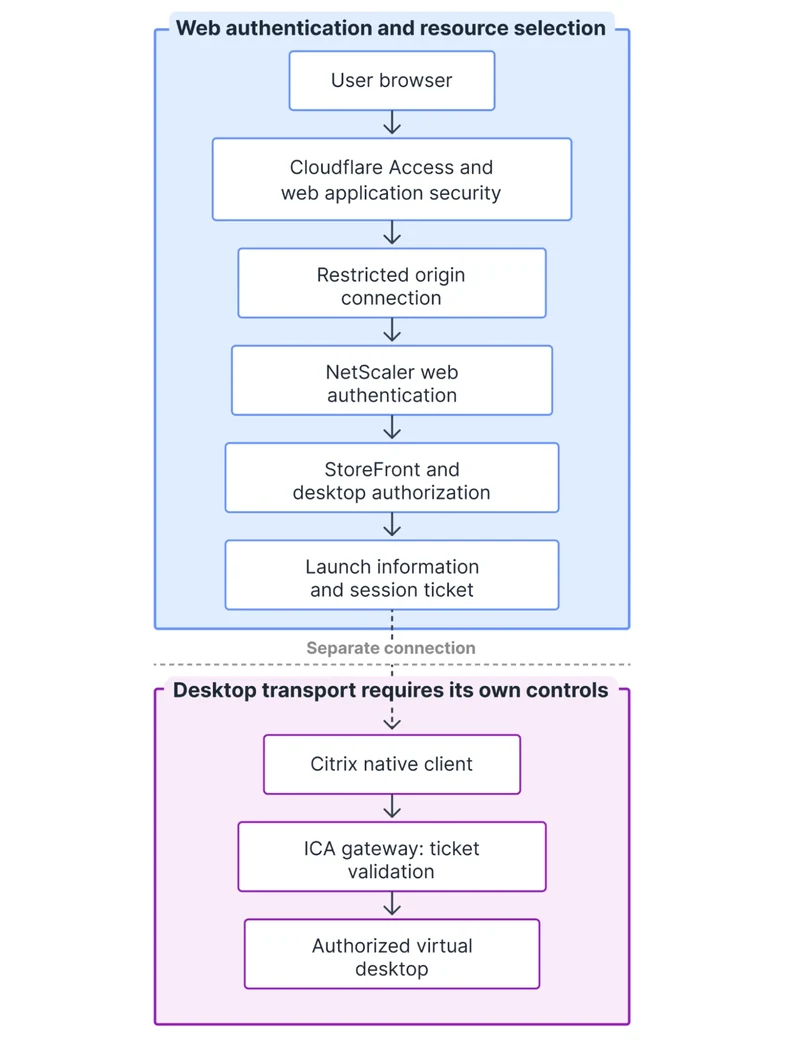
In a standard Citrix deployment, users authenticate through the NetScaler Gateway before being passed to StoreFront via a secure ticket authority. Because the gateway must remain publicly accessible on the Internet for users to initiate remote sessions, it presents an inherent exposure risk.
To mitigate this architectural risk, organizations can implement independent access policies that evaluate requests before they ever reach the target server. By positioning single sign-on boundaries in front of the authentication server, security policies determine whether a user should even be granted access, neutralizing exploit attempts before they interact with vulnerable gateway code.
Enforcing Strict Origin Boundaries
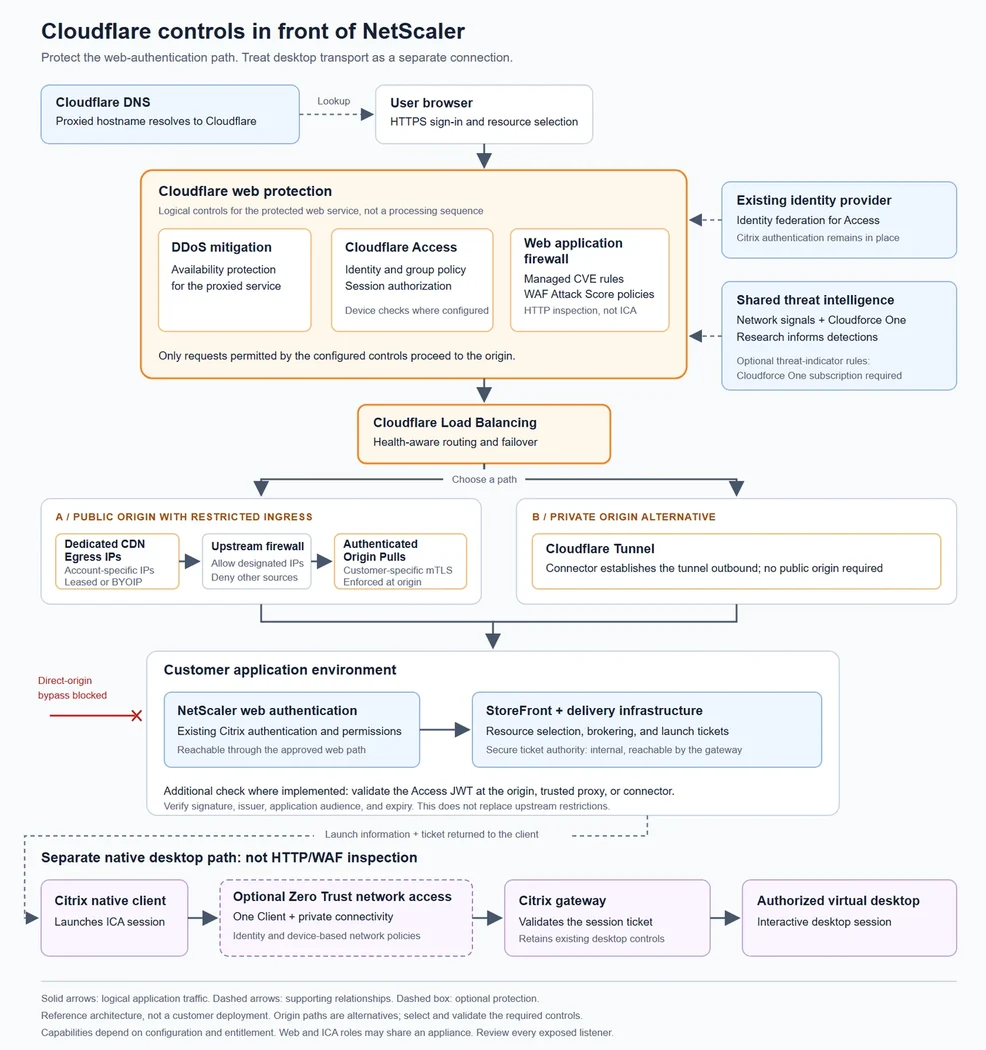
Simply changing DNS configurations and deploying access policies is not enough to secure an infrastructure. If an attacker can directly connect to an origin server's IP address or an alternate hostname, front-end security controls can be bypassed entirely.
To prevent direct connections from circumventing security policies, organizations must ensure that all incoming traffic is validated. Implementing outbound-only secure tunnels allows teams to close all inbound IP traffic to application servers, eliminating the risk of a publicly reachable origin IP address.
Sources
- Cloudflare BlogBeyond the patch: Protecting your NetScaler gateway against future vulnerabilities
Continue chronologically


Related entity coverage
Related stories
Hackers Exploit Citrix NetScaler Zero-Day Vulnerabilities
Cybersecurity firms report that attackers are actively exploiting Citrix NetScaler zero-day vulnerabilities to deploy web shells and tunneling malware.

NetScaler Zero-Day Attacks Hit Government and Finance Sectors
Government and financial organizations in North America and Europe face weeks-long zero-day attacks exploiting NetScaler vulnerabilities.

Citrix NetScaler Zero‑Day CVE‑2026‑88779 Exploited
A new high‑severity memory overflow in Citrix NetScaler (CVE‑2026‑88779) was exploited days after patches, prompting CISA action and urgent mitigation steps.

Citrix Patches NetScaler SAML Zero-Day Exploited in Attacks
Citrix has released emergency updates for a new NetScaler SAML denial-of-service zero-day vulnerability tracked as CVE-2026-88779.