
Building the Business Case for Agentic Automation
A new framework for AI center of excellence leaders helps organizations accurately measure the total economic impact of agentic automation beyond basic labor cost calculations.
 Radwan AbdulhadiEditor and technology writer
Moving Beyond Traditional ROI Models
Agentic automation, which involves software capable of reasoning and adapting to complete tasks, is increasingly appearing on the roadmaps of AI centers of excellence. However, the standard method companies use to justify automation investments—multiplying hours saved by labor cost and subtracting build cost—was originally designed for rule-based robotic process automation tools like RPA. According to recent insights on agentic AI change management, this legacy approach misses the majority of value that modern agents generate. Further details are available from AWS Machine Learning Blog in the original source material.
The traditional return on investment model assumes a stable environment, ignoring the ongoing maintenance costs required as workflows change. Because these systems were built for rule-based tasks, they lack line items for exceptions or human oversight, often treating saved hours as immediate financial gains even when freed capacity simply fills with backlogs.
The Agentic Value Model Framework
To capture the complete financial and operational picture, leaders can utilize a comprehensive evaluation method known as the Agentic Value Model. This framework assesses four core dimensions of value: time savings, exception handling, decision quality, and change resilience alongside maintenance economics.
When assessing human-process costs, guidance documents note that error corrections and human errors represent significant portions of operational expenses. Factoring in rework multipliers and error percentages provides a clearer baseline for financial planning than labor-only calculations.
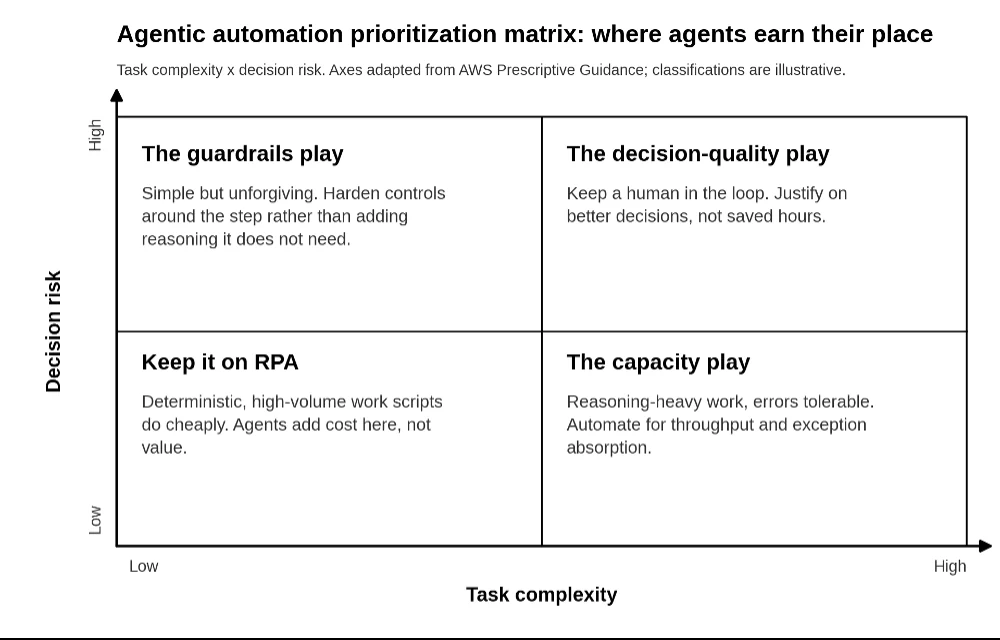
Furthermore, understanding agentic AI economics demonstrates that low-volume, high-value decisions often justify agent deployment primarily for enhanced decision quality rather than direct cost reduction alone.
Addressing Process Redesign and Adoption
Successful AI transformations depend heavily on how organizations invest around the technology rather than just within the tool itself. Successful programs often follow a structured investment pattern where organizations dedicate substantial resources to process redesign, capability building, and user adoption.
Realizing the true value of agentic automation requires reshaping workflows around agents rather than simply dropping them into unchanged, legacy procedures. Without proper governance and value realization mechanisms, freed hours may fail to translate into tangible P&L savings.
Practical Deployments and Real-World Examples
Practical applications of these economic principles can be observed through early deployments utilizing Amazon Quick Automate. Organizations across different sectors leverage these advanced automation capabilities to streamline complex administrative and operational workflows.
By evaluating initiatives through a multi-dimensional lens that includes error reduction, maintenance economics, and decision support, enterprises can build robust, defensible business cases for their agentic automation roadmaps.
Sources
- AWS Machine Learning BlogBeyond hours saved: Building the business case for agentic automation
Continue chronologically

Related entity coverage
Related stories
AWS Introduces Agentic Conversational Video Intelligence
Amazon Web Services details a new agentic conversational video intelligence solution using Amazon Bedrock, Rekognition, and Transcribe.
Qlik Builds Grounded Enterprise AI With Amazon Bedrock
Learn how Qlik leverages Amazon Bedrock and a multi-agent architecture to deliver trusted enterprise AI at a global scale for its customers.
Manage SageMaker HyperPod Spaces Directly from Studio
Data scientists and machine learning engineers can now create, configure, start, stop, and open Amazon SageMaker Spaces directly from SageMaker Studio.
Amazon and Synopsys Sign Multi-Year AI Chip Deal
Amazon and Synopsys have inked a multi-year, billion-dollar partnership to accelerate AI chip design using advanced EDA tools and AWS services.