Agentic Retrieval with LangChain and Amazon Bedrock
A new architectural approach combines LangChain with Amazon Bedrock to address the limitations of single-shot vector searches when handling multi-faceted queries.
 Radwan AbdulhadiEditor and technology writer
The Limitations of Single-Shot Retrieval
When users query a support assistant or Retrieval Augmented Generation (RAG) application with complex inquiries, traditional similarity searches often fall short. For example, asking an application built with <a href="https://github.com/langchain-ai/langchain-aws">LangChain</a> to compare multiple products across several dimensions simultaneously forces a single query vector to encapsulate every distinct intent. Although the resulting answer may appear concise and error-free, the retrieved chunks often only cover a fraction of the user's actual questions.
To solve this issue, developers can implement advanced query strategies using fully managed RAG capabilities available through <a href="https://aws.amazon.com/blogs/aws/introducing-amazon-bedrock-managed-knowledge-base-for-faster-more-accurate-enterprise-ai-applications/">Amazon Bedrock Managed Knowledge Base</a>. This managed service removes the complexity of self-managed vector stores, custom embedding pipelines, and re-ranking models from the underlying architecture.
Understanding Agentic Retrieval
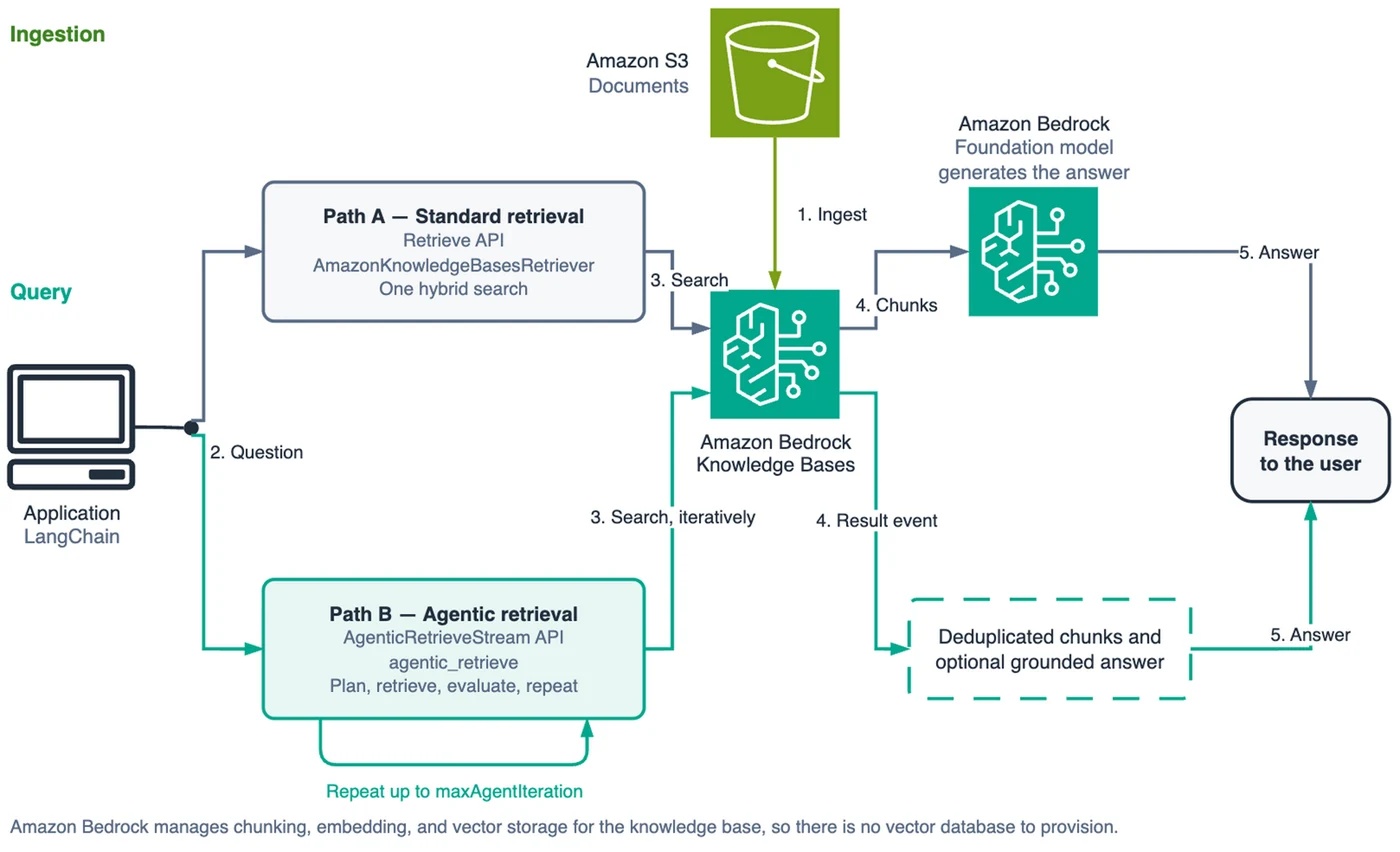
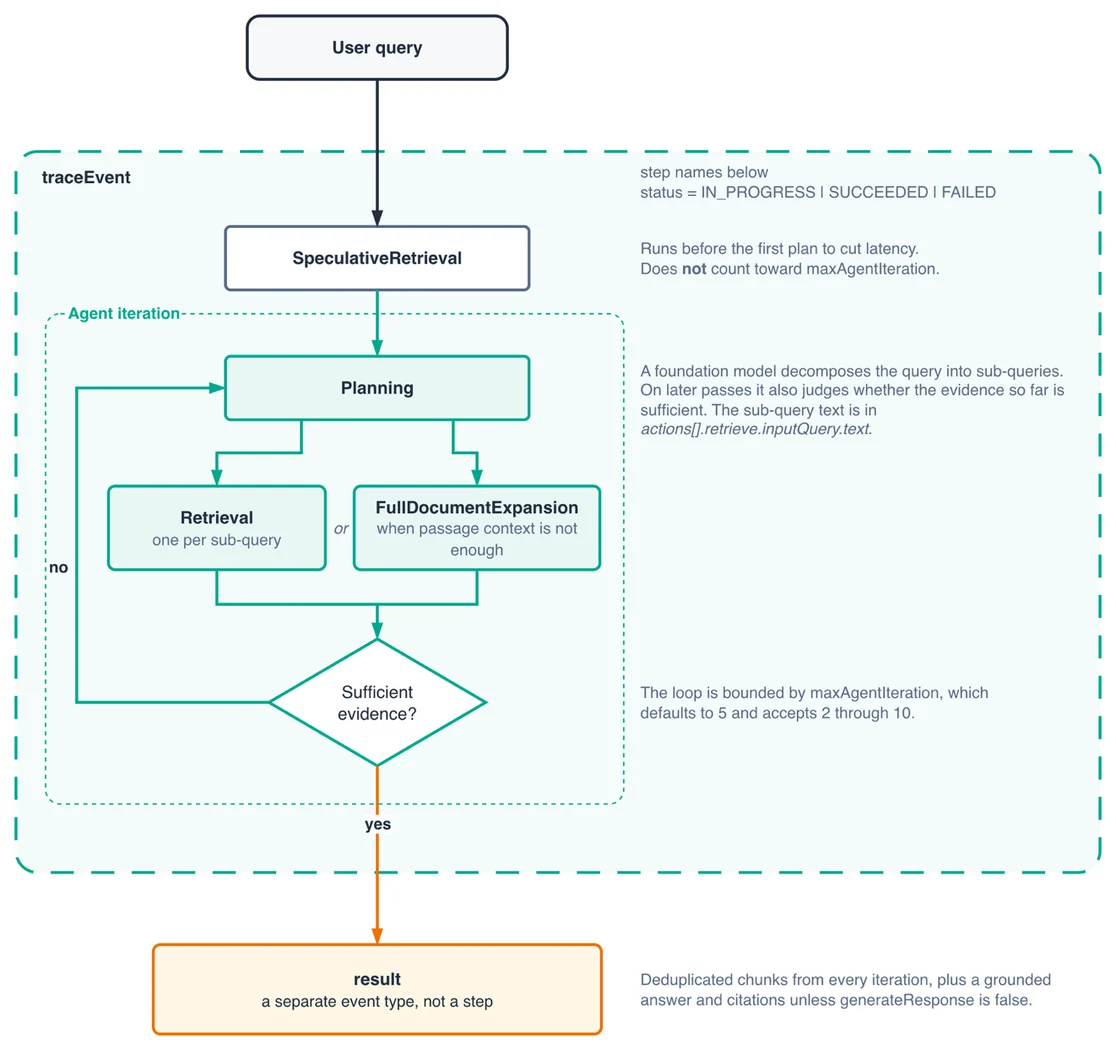
Unlike standard single-shot retrieval methods, agentic retrieval actively plans the information-gathering process. Instead of executing a single search, the system breaks down complex questions into distinct sub-queries, executes them iteratively, judges whether gathered evidence is sufficient, and performs additional searches if necessary. This workflow allows enterprise applications to handle multi-part questions accurately by gathering comprehensive context before generating a grounded response.
The underlying architecture utilizes managed data sources typically hosted on <a href="https://aws.amazon.com/pm/serv-s3/?trk=50b671a1-06f5-4224-9505-fa45ee881c08&sc_channel=ps&ef_id=EAIaIQobChMI1uiUo4eXlgMVy1J_AB2pfydUEAAYASAAEgJ6PPD_BwE&gads_camp=23522747487&gads_ag=196433733807&gads_ad=795876995201&gads_kw=amazon%20s3&gads_matchtype=e&gads_network=g&gads_device=c&gads_geo=9022830&gad_campaignid=23522747487&gbraid=0AAAAADjHtp-DJgH1kF6NUslUNqoqqj14q&gclid=EAIaIQobChMI1uiUo4eXlgMVy1J_AB2pfydUEAAYASAAEgJ6PPD_BwE">Amazon Simple Storage Service (Amazon S3)</a> to store sample documents and source corpora. Developers can review specific trace events to audit the reasoning path and planning steps produced by the model during execution.
API Options and Implementation Details
Amazon Bedrock Managed Knowledge Bases provides multiple API endpoints to support different retrieval behaviors. The standard <a href="https://docs.aws.amazon.com/bedrock/latest/APIReference/API_agent-runtime_Retrieve.html">Retrieve</a> API executes a single hybrid search returning scored chunks of data. Conversely, the <a href="https://docs.aws.amazon.com/bedrock/latest/APIReference/API_agent-runtime_AgenticRetrieveStream.html">AgenticRetrieveStream</a> API manages the multi-step planning loop and streams progress steps back to the application as trace events.
When building solutions with these capabilities, developers must configure appropriate AWS Identity and Access Management roles and permissions. Application components should use supported runtime tools alongside <a href="https://boto3.amazonaws.com/v1/documentation/api/latest/index.html">Boto3</a> libraries to interact with the managed infrastructure. It is essential to ensure that Boto3 versions meet or exceed the requirements necessary for streaming agentic retrieval functions.
Cost Considerations and Best Practices
Implementing multi-step agentic workflows introduces additional considerations regarding operational expenses. Running iterative planning loops, continuous document ingestion, and extended foundation model inference calls can influence overall application expenditures compared to single-shot queries. Developers should consult official documentation regarding <a href="https://aws.amazon.com/bedrock/pricing/">Amazon Bedrock pricing</a> to analyze cost structures for storage, ingestion, and retrieval operations.
To maintain optimal performance and cost-efficiency, teams are advised to review regional compatibility guidelines within the primary <a href="https://docs.aws.amazon.com/bedrock/latest/userguide/models-region-compatibility.html">documentation</a> before deploying knowledge bases and agentic retrieval features into production environments.
Sources
- AWS Machine Learning BlogAgentic retrieval with LangChain and Amazon Bedrock Knowledge Bases
Continue chronologically
Related entity coverage
Related stories
Query Claims in Natural Language With Amazon Bedrock
Learn how to build a conversational claims assistant using Amazon Bedrock Knowledge Bases to answer natural-language queries with citations.
Building Ambient Agents with Amazon Bedrock AgentCore
Learn how to build framework-agnostic ambient agents on Amazon Bedrock AgentCore that respond to event-driven signals and human-in-the-loop workflows.
AWS Introduces Agentic Conversational Video Intelligence
Amazon Web Services details a new agentic conversational video intelligence solution using Amazon Bedrock, Rekognition, and Transcribe.
Build Multi-Agent Pipelines with Amazon Bedrock AgentCore
Learn how to build a multi-agent music production pipeline on Amazon Bedrock AgentCore Runtime Instances using shared sessions and GPU infrastructure.