OpenAI Introduces Rosalind Academic Plan for Labs
The new plan offers academic research laboratories sponsored access to specialized life sciences AI tools and frontier models.
 Radwan AbdulhadiEditor and technology writer

Bringing GPT-Rosalind to Academic Labs
OpenAI has officially launched the Rosalind Academic Plan, designed to help academic scientists gain access to GPT-Rosalind. According to OpenAI News, the dedicated life sciences model combines frontier reasoning with the Rosalind workbench to enable specialized tool orchestration across genomics, medicinal chemistry, wet-lab assistance, and other scientific applications.
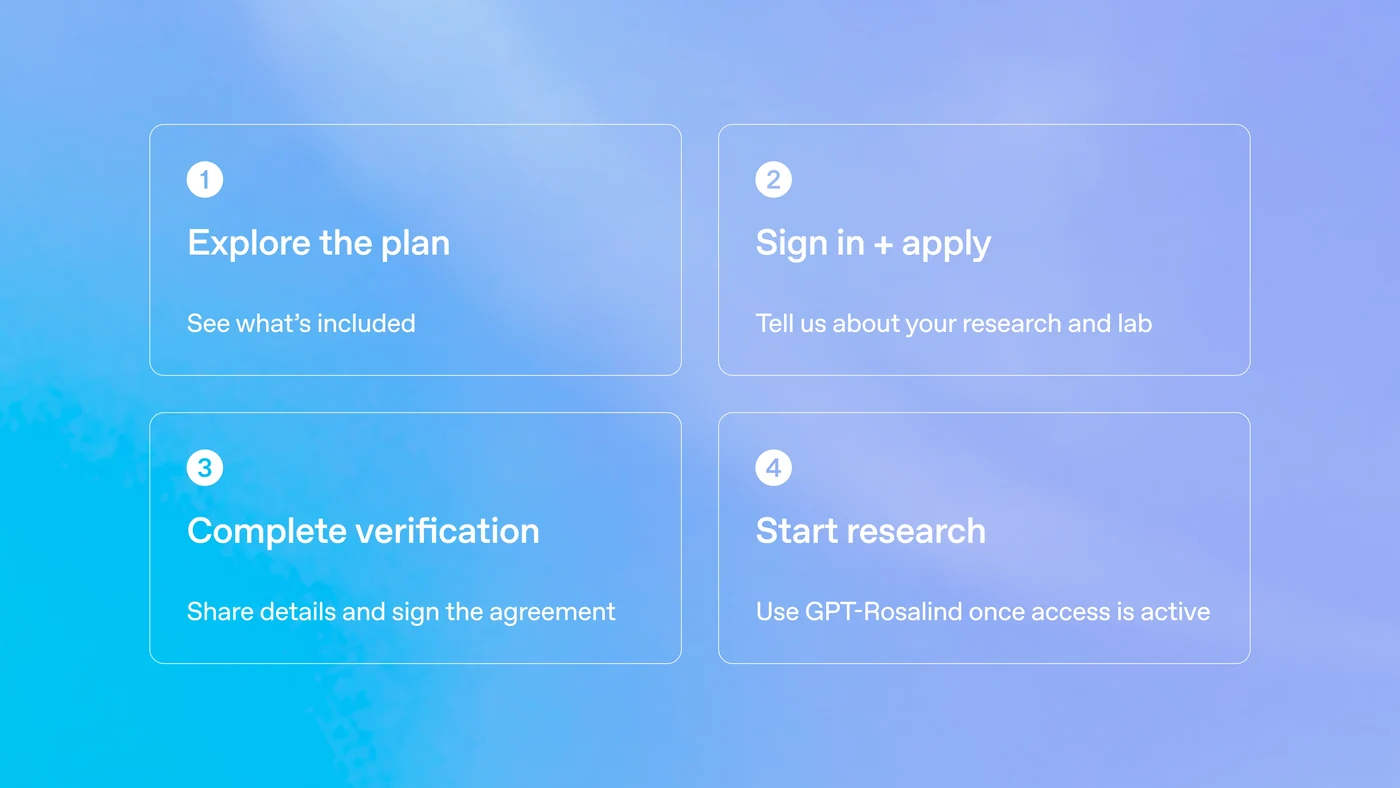
Under the new offering, eligible academic research laboratories can receive up to 30 Business Standard seats at no cost for up to 12 months. Access to GPT-Rosalind through this initiative remains subject to trusted-access approval by the organization.
Supporting Foundational Research and Scientific Discovery
Accelerating scientific discovery remains a central goal within OpenAI's mission to ensure that artificial general intelligence benefits humanity. Historical breakthroughs, such as the Human Genome Project, CRISPR-Cas9, and mRNA research, demonstrate how curiosity-driven university work can ultimately transform medicine, biotechnology, and agriculture.
By helping academic scientists combine their expertise and judgment with advanced AI tools built specifically for life sciences research, the initiative aims to support discoveries whose benefits reach far beyond the laboratory environment. Distinguished academic labs are already exploring how the technology can assist with tasks ranging from protein design to understanding neurodegeneration.
Plan Features and Model Access Details
Academic researchers utilizing the Rosalind Academic Plan gain several specific benefits designed to support complex scientific workflows. The plan provides up to 30 Business Standard seats at zero dollars per user per month for a maximum of 12 months, alongside access to all commercially available frontier OpenAI models subject to plan usage limits.
Furthermore, OpenAI notes that research data shared through the Rosalind Academic Plan is not used to train its models by default. However, direct API access is not included in the plan at this initial stage.

Specialized Life Sciences Capabilities
GPT-Rosalind is built as a specialized life sciences model designed to support deeper reasoning regarding complex biological questions. Approved researchers can leverage trusted access to investigate sensitive scientific topics within safeguards specifically tailored for legitimate research contexts.
The model is equipped to assist with designing candidate drugs, therapeutic proteins, peptides, and enzymes while optimizing their molecular interactions. Additional applications cover identifying molecular signatures of disease, developing liquid biopsies, evaluating antibodies and vaccines against emerging viral variants, correcting genetic defects, and investigating agricultural or environmental biology.

Eligibility, Application, and Safety Requirements
The Rosalind Academic Plan is currently available to academic laboratories located at U.S. universities. Principal investigators and lab leads at eligible organizations without an existing OpenAI Enterprise agreement can apply through the trusted access process, while labs at institutions with an existing agreement must apply through their university's designated Enterprise access path.
The rigorous verification and onboarding process involves validating institutional legitimacy, confirming the principal investigator's identity and professional background, reviewing intended research activities, and establishing clear responsibilities with an institutional safety contact. Comprehensive details regarding requirements and getting started are available via the help center guide.
Sources
- OpenAI NewsBringing GPT-Rosalind to academic research labs
Continue chronologically

Related entity coverage
Related stories
OpenAI, PerturbAI and Scripps Research Deploy AI Agents
OpenAI, PerturbAI, and Scripps Research use thousands of distributed AI agents to analyze complex biological data from millions of brain cells.
OpenAI Prepares New Math Releases Amid Academic Tensions
OpenAI plans to release over 100 new solutions to unsolved math problems, drawing criticism from mathematicians over communication and research attribution.

OpenAI Introduces LifeVal Benchmark for Everyday Tasks
OpenAI has introduced LifeVal, a new benchmark designed to measure how effectively artificial intelligence assists people with daily tasks.
Former OpenAI Science Lead Launches Warp Sciences to Automate Wet Labs
Former OpenAI science lead Kevin Weil has launched Warp Sciences, an AI startup raising $215 million to automate wet labs for drug discovery using robots.