Sapienz Receives ISSTA 2026 Impact Paper Award
Researchers Ke Mao, Mark Harman, and Yue Jia have been honored with the ACM SIGSOFT International Symposium on Software Testing and Analysis (ISSTA) 2026 Most Influential Paper Award for their 2016 work on automated testing.
 Radwan AbdulhadiEditor and technology writer
Recognizing a Decade of Automated Testing Research
The creators of a prominent software testing methodology have been recognized for a decade of academic and practical impact. Ke Mao, Mark Harman, and Yue Jia received the ACM SIGSOFT International Symposium on Software Testing and Analysis (ISSTA) 2026 Most Influential Paper Award for their 2016 research titled "Sapienz: multi-objective automated testing for Android applications."
The recognized work originated at University College London before transitioning into core testing infrastructure at Meta. The original study combined three main objectives: exploring broader areas of an application, identifying a higher volume of crashes, and reducing the total number of steps required to trigger those failures.
Evaluation and Scaling at Meta
During its initial evaluation across 1,000 popular Google Play applications, the automated testing approach successfully detected 558 previously unknown crashes. By helping engineers reproduce crashes in fewer steps, the system made failures significantly easier to investigate and resolve.
Within 17 months of its initial publication, the framework was deployed at scale across Meta. Today, it operates at a massive scale by running millions of tests daily across various company platforms, surfacing thousands of unique crashes each week, and safeguarding hundreds of app releases every month.
Expansion Into WhatsApp and Dynamic Taint Analysis
The utility of the testing framework quickly grew beyond standard crash detection. By utilizing test accounts configured with synthetic conversations, the software evolved to serve as the app-exploration engine for dynamic taint analysis at WhatsApp.
This expansion demonstrated the adaptability of multi-objective exploration techniques in addressing complex security and privacy evaluations across different messaging environments.
From Intelligent Testing to Autonomous Agents
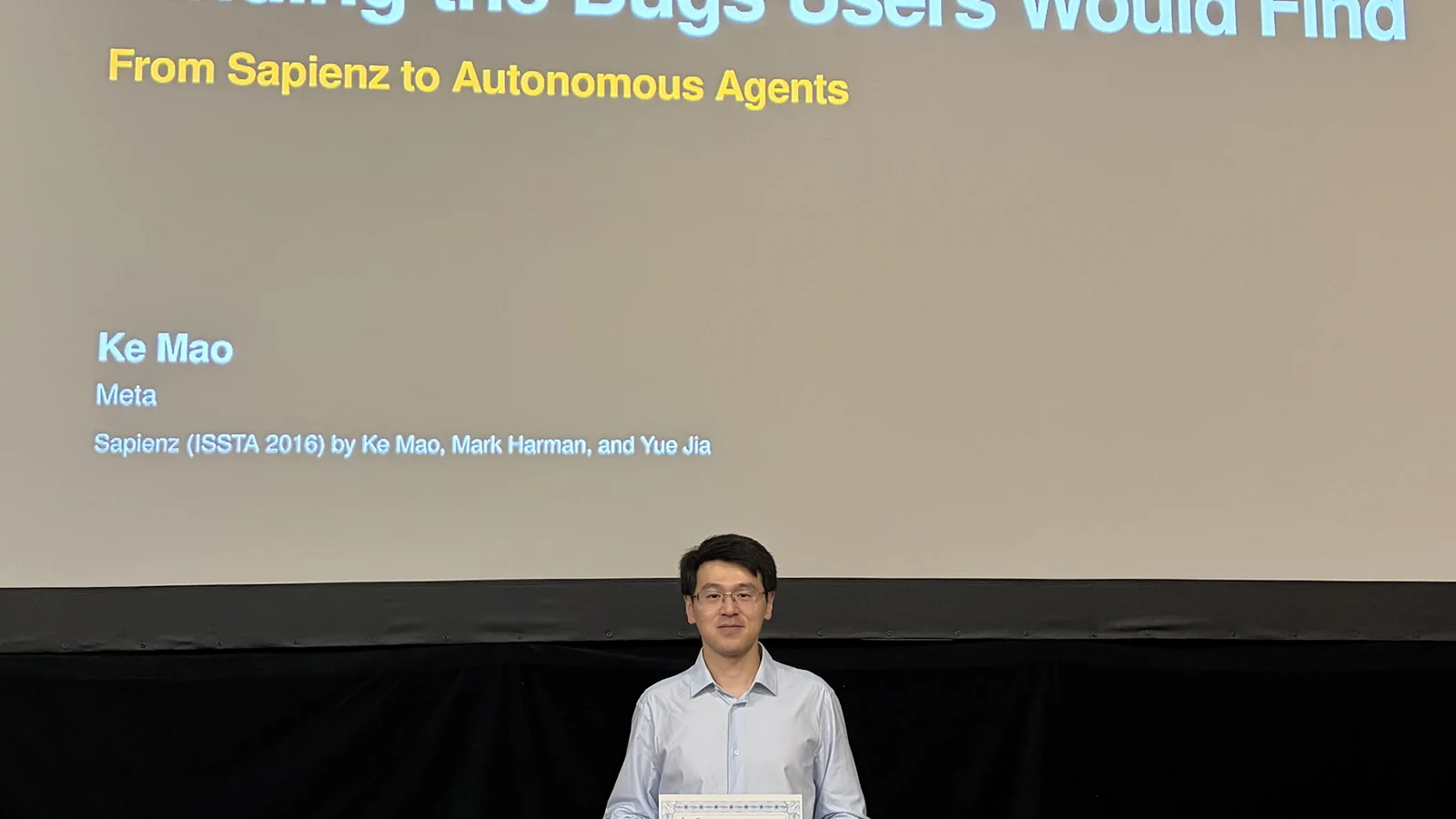
The ongoing evolution of the technology was highlighted during an ISSTA 2026 keynote delivered by Ke Mao, titled "Finding the Bugs Users Would Find: From Sapienz to Autonomous Agents." The presentation explored how modern large language model (LLM) agents can navigate applications and reason about whether observed behaviors align with user expectations.
This shift extends automated testing capabilities beyond traditional reliability checks into functional correctness and automated repair. According to project stakeholders, the founding principles established a decade ago remain directly relevant to these modern agentic workflows.
Privacy, Risk Management, and Development Safeguards
The integration of advanced testing methodologies forms a key component of Meta's broader risk management and privacy programs. Company engineering teams utilize these automated insights to identify potential risks earlier in the software development lifecycle.
By applying technical safeguards more consistently, development teams can incorporate privacy protections directly into new product innovations from the initial stages of design.
Sources
- Meta EngineeringSapienz Receives ISSTA 2026 Impact Paper Award
Continue chronologically


Related entity coverage
Related stories
Meta Infrastructure Sets Records During 2026 World Cup
Meta details how its infrastructure handled record-breaking messaging, live video watch times, and traffic spikes during the 2026 World Cup.
WhatsApp Help Pages Leak Hidden Instructions for Meta Chatbot
Dozens of WhatsApp help pages inadvertently exposed hidden chatbot instructions and guidelines on what not to say, which Meta attributed to a bug.

Meta Brings Private Processing Infrastructure to AI Glasses
Meta expands its Private Processing confidential computing infrastructure to AI glasses, enabling secure cloud-based AI processing without exposing user data.

Instagram Direct Builds AI-Native UI with Jetpack Compose
Instagram Direct engineers rebuilt their Android UI architecture using Jetpack Compose, cutting token costs by 33% and codebase size by 50%.