Bluesky Expands Attie AI Tool to Build Social Apps and Games
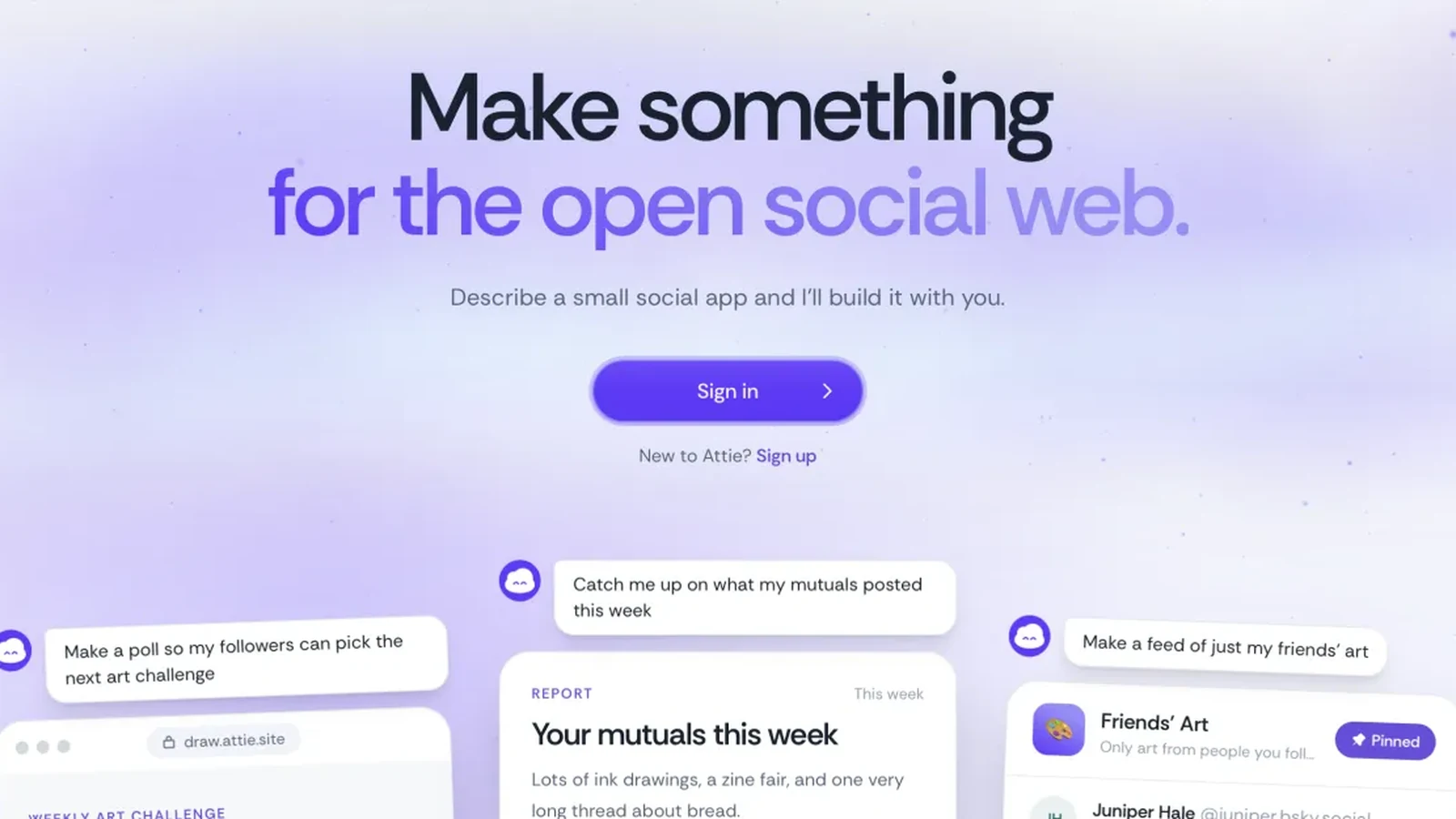
Bluesky is broadening the capabilities of its Attie AI tool, transitioning the feature from custom feed generation to the creation of lightweight social applications, games, polls, and interactive dashboards.
 Radwan AbdulhadiEditor and technology writer
Evolution of the Attie AI Tool
Bluesky is scaling up the functionality of its proprietary artificial intelligence tool, shifting its primary focus beyond basic feed customization. Initially launched earlier this year as a dedicated utility to help users construct personalized feeds utilizing artificial intelligence, the platform is now taking a much broader step forward.
The updated system empowers community members to design and deploy small-scale social applications, interactive polls, data dashboards, and browser-based games. These creations are not confined to the main Bluesky application ecosystem; instead, they can be shared directly with other users as independent websites hosted on custom subdomains.
Vibe Coding for Communities
During a live discussion [at TechCrunch Disrupt](https://techcrunch.com/2026/10/15/bluesky-expands-its-ai-powered-attie-app-to-let-anyone-build-websites-games-and-more/), Bluesky Chief Executive Officer Toni Schneider detailed the vision behind the expanded feature set. Schneider encouraged observers and developers to think of Attie as a form of social vibe coding or vibe coding tailored specifically for an online community.
This philosophy leans into the growing trend of conversational software generation, where everyday users can bypass traditional programming languages and rely instead on natural language prompts to manifest functional digital experiences. By lowering the technical barrier to entry, Bluesky aims to foster higher levels of community engagement and creative expression directly tied to social network interactions.
Creating Polls and Lightweight Apps via Prompts
Building a custom application with the system requires little more than writing a descriptive prompt detailing the desired functionality. For instance, generating a straightforward preference poll, such as a [simple poll I made](https://whisking-humble-garden.attie.site/) regarding classic video game iterations, takes only a matter of minutes from initial text input to functional output.
While simple polling mechanisms are easy to instantiate, the underlying architecture is flexible enough to support considerably more complex interactive concepts. The generation process handles layout logic, interactive elements, and basic user interface design based entirely on the guidance provided by the human creator's natural language descriptions.
Featured Examples and Novelty Projects
To showcase the broader potential of the expanded software, the official [Attie website](https://humming-loyal-zeppelin.attie.site/) currently highlights several prominent community-built demonstrations. These curated selections illustrate the variety of experiences that can be brought to life using automated generation workflows.
Among the featured titles is a retro arcade interpretation dubbed the [“Flappy Butterfly” Flappy Bird clone](https://savoring-proud-chime.attie.site/), which adapts classic obstacle-avoidance mechanics into a browser-friendly social web page.
Other highlighted projects include a functional interactive instrument structured as [a drum machine](https://gleaming-perky-latte.attie.site/), an assessment tool configured as [a quiz](https://gleaming-giddy-bonnet.attie.site/), and an incremental progression game framed as [an idle clicker about a celery man](https://humming-loyal-zeppelin.attie.site/).
Domain Structure and Attribution
Every social application created through the platform is assigned a distinct custom web address operating directly on the attie.site domain. This allows creators to distribute their interactive projects seamlessly across various messaging channels and social timelines without requiring external web hosting setup.
To maintain accountability and give credit to creators, the generated web pages feature explicit attribution markers located at the bottom of the screen, clearly identifying who built the specific social application. While many of the current iterations function primarily as lightweight novelties rather than deep enterprise software, they provide a compelling glimpse into user-generated utility powered by generative artificial intelligence.
Sources
- The VergeBluesky’s AI tool now lets you make games and apps to share on social
Continue chronologically


Related stories
Benchmark Partners Discuss Strategy in a Frenzied Market
Benchmark's partners discuss their investment pace, fund expansion, and small team dynamics at TechCrunch Disrupt in San Francisco.

Amazon's Panos Panay Envisions Ambient AI Replacing Apps
Amazon devices chief Panos Panay discussed a future of ambient computing and personal AI wearables at TechCrunch Disrupt, looking beyond traditional apps.
Efferon tackles pediatric sepsis with blood-purification tech
Efferon, a startup featured in TechCrunch Disrupt 2026’s Startup Battlefield 200, develops blood purification tech to combat pediatric sepsis.

Bluesky Blocks Links to Leaked DHS Personnel Data
Social network Bluesky blocks links to a leaked archive of Department of Homeland Security employee records, citing policy violations.