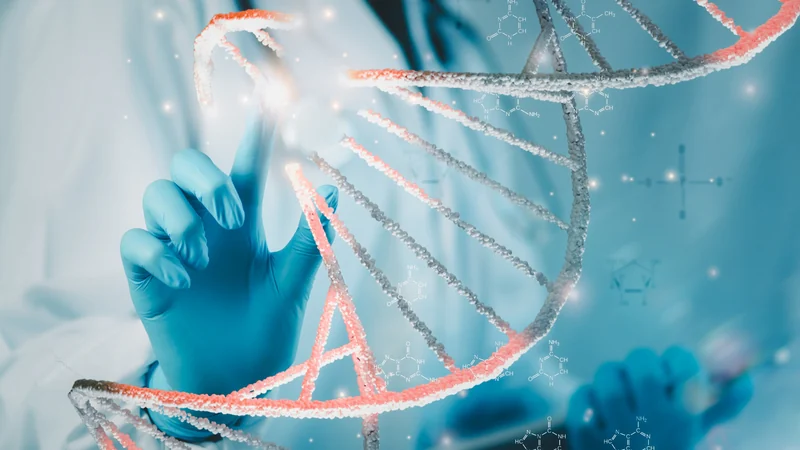
Why AI Struggles to Decode Our Convoluted Genomes
The human genome is far more dynamic than a simple computer script, presenting deep challenges for both scientists and artificial intelligence models trying to decode its intricate mechanisms.
 Radwan AbdulhadiEditor and technology writer

The Illusion of the Genomic Blueprint
Since its molecular structure was deduced in the 1950s, DNA has been hailed by many biologists as the secret of life. Researchers have long studied the genetic database found within living organisms, often describing it as a blueprint, code script, or computer. However, if DNA truly harbors a grand secret about how life operates, biologists are still working to fully uncover it.
The international Human Genome Project successfully mapped nearly the entire sequence between 1990 and 2003, determining the order of roughly 3 billion chemical building blocks. Yet, having this comprehensive data did not instantly solve biological complexities. Investigators discovered that barely 2 percent of the human genome consists of actual genes, which serve as the information-coding sequences.
Shifting Focus From Genes to Regulation
Modern biology indicates that understanding the human genome extends far beyond cataloging what individual genes do. The much harder question focuses on how those genes are used and regulated. By switching specific suites of genes on and off, diverse cell types throughout the body can develop from identical genetic material. Cells also continuously regulate their genes in real time, reacting to incoming signals from neighboring surroundings.
Traditional protein production involves transcribing DNA into messenger RNA via an enzyme called polymerase, followed by translation via the ribosome. While this two-stage model remains accurate, Harvard Medical School biologist Karen Adelman notes that genes themselves may not be the most captivating part of the genome. The true complexity lies in the regulatory mechanisms controlling these sequences.
Turning to Artificial Intelligence
Faced with processes so intricate that their full comprehension remains daunting, some researchers are turning to artificial intelligence. Genomic foundation models such as Evo 2, Genos, and Google DeepMind’s AlphaGenome are trained on vast quantities of genomic data. Biologists utilize these systems to generate predictions regarding how DNA sequence variations impact biological processes and organism traits, including overall disease risk.
These algorithms bypass the messy details of regulatory control by relying on training datasets to deduce correlations from known cases. While useful, experts note that relying on a computational black box fails to deliver genuine insight into how life works. Furthermore, the genome itself may fundamentally resist the straightforward input-output approach that AI models inherently assume.
Evolutionary Complications in Eukaryotic Cells
Shaped by roughly 4 billion years of evolution, the genome features unexpected complexities that defy simple design principles. As Karen Adelman observed, our genome is not what someone would construct starting from a blank drawing board. Unlike simpler organisms like bacteria, where regulatory principles are relatively straightforward, complex eukaryotic organisms feature overlapping systems of oversight and control.
Transcription factors act as the operations managers of gene regulation by binding to DNA and recruiting polymerase enzymes. In bacteria, these factors operate like distinct keys fitting unique locks. In humans, however, transcription factors lack strong preferences for specific binding sites, typically functioning in groups and exhibiting context-dependent effects where they can activate transcription in one cell type and suppress it in another.
Boolean Logic and the Puzzle of Enhancers
Regulatory logic also differs sharply between organisms. Bacterial regulation often relies on a simple "OR" logic where specific signals turn genes strictly on or off. By contrast, the human genome functions closer to computer science "AND" logic, integrating multiple signals to reach nuanced regulatory decisions with tunable controls rather than binary switches.
Adding to this intricacy are enhancers, which serve as gathering points for transcription factors and deliver signals for polymerases to begin transcription. Mapping these elements presents an ongoing puzzle, as the human genome contains hundreds of thousands or even millions of enhancers—outnumbering actual genes—with individual genes influenced by multiple enhancers and vice versa.
Sources
- WIREDWhy AI Isn’t Ready to Tackle Our Convoluted Genomes
Continue chronologically


Related stories
Google DeepMind Unveils Antigravity Cheminformatics
Google DeepMind introduces Google Antigravity with new Cheminformatics Skills to accelerate drug discovery workflows and design novel macrocycles.

Google DeepMind Announces Gemini 4 Carbon
Google DeepMind introduces Gemini 4 Carbon, its strongest frontier AI model featuring advanced cybersecurity capabilities and long-horizon engineering performance.

Google DeepMind Unveils Genie 4 World Simulation Model
Google DeepMind introduces Genie 4, a new real-time interactive world simulation model featuring native audio, advanced physics, and Gemini integration.
UK Launches $134M AI Biosecurity Lab for Safety
The UK government has established a new $134 million AI Biosecurity Lab backed by major tech firms to detect biological threats and accelerate vaccines.