Developers Turn Ideas Into Simulations With Frontier AI Agents
Developers are leveraging frontier AI models alongside NVIDIA Omniverse libraries to streamline the process of transforming simulation ideas into working, interactive applications.
 Radwan AbdulhadiEditor and technology writer
Bridging Ideas and Simulation
Turning a simulation idea into a working application traditionally requires assembling assets, connecting physics and rendering, and carefully checking that the scene behaves as intended. To streamline this process, developers are combining frontier AI models with NVIDIA Omniverse libraries to carry out that work. These combined systems help build applications tailored for exploring scenarios, investigating failures, and improving overall designs.
Rather than building every element from scratch, developers direct AI agents through natural-language instructions, review the generated results, and guide subsequent changes. The underlying NVIDIA Omniverse libraries provide GPU-accelerated physics, rendering, and sensor simulation capabilities to bring these virtual environments to life. More details can be found directly on the NVIDIA Blog.
Building Humanoid and Warehouse Simulators
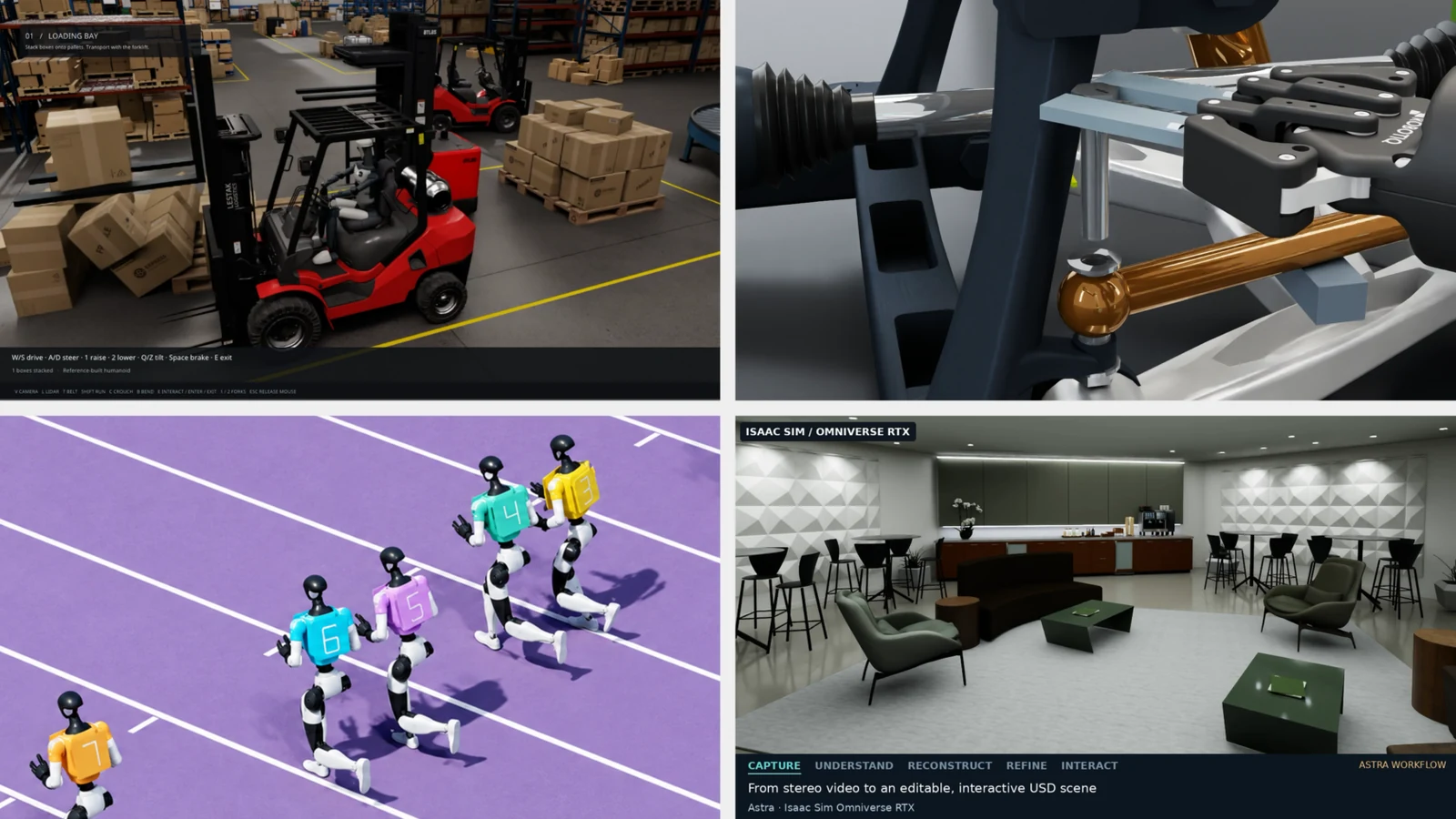
Before automating complex warehouse tasks, developers need interactive simulation environments to explore task behavior and evaluate how work is executed. Frank DeLise, an Omniverse product manager at NVIDIA, used advanced AI models to turn a SimReady warehouse and humanoid robot into an interactive simulator featuring first- and third-person views.
DeLise directed the AI agent to connect specific NVIDIA Omniverse libraries for physics, scene updates, rendering, and the user interface. He also utilized the agent alongside foundation assets to create the physical scene in simulation, allowing the model to generate the necessary animation and application code to unify those capabilities.
Autonomous-Driving Testing and Sensor Validation
Modifying a scene, sensor, or driving model can significantly impact autonomous-vehicle simulations. Doyub Kim, a manager on the simulation technology team at NVIDIA, tasked an AI agent with building a reusable simulation environment based on San Francisco’s Market Street. The agent mapped out the workflow and connected asset creation, traffic, RTX sensor simulation, and driving models in stages.
To ensure accuracy, developers must understand how closely simulated sensors match real-world equipment. Ashley Reid, who works on RTX sensor validation at NVIDIA, directed AI agents to compare camera and raw LiDAR outputs with recorded data. The iterative workflow allowed agents to measure differences, create or modify OpenUSD scenes, and address missing objects, geometry, and materials based on specific camera and LiDAR metrics.
Testing Robot Skills and Robotic Disassembly
Teaching robots new movements involves verifying whether those actions function properly under strict physical constraints. Tae Kim, who leads NVIDIA Omniverse engineering and product, used sports videos and natural-language instructions to guide an agent in building an experimental project that tests simulated humanoids performing sports movements.
In a separate engineering challenge, Jens Jebens, a senior product manager for OpenUSD at NVIDIA, directed an AI agent to model a car suspension in computer-aided design software and configure it in Isaac Sim. The agent measured available space and designed a custom wrench that the robot could use to successfully reach and remove suspension bolts in simulation, connecting design choices directly to robotic tooling decisions.
Expanding Virtual Environments to Space and Captured Rooms
Translating 3D models into fully functional web applications requires connecting complex assets, live data, and interfaces. Nic Johns, an engineering director at NVIDIA, prompted an AI agent to assemble NASA assets into an OpenUSD International Space Station model complete with live telemetry, bringing operational space data directly into the browser environment.
Similarly, Chirag Majithia from the Isaac engineering applications team directed an AI agent to convert stereo camera captures into an editable OpenUSD studio. By combining reconstruction techniques with user reviews, the workflow allowed agents to configure object interactions and test collisions for doors and drawers, bridging captured physical geometry with interactive testing.
Sources
- NVIDIA BlogInto the Omniverse: How Developers Turn Ideas Into Simulations With Frontier AI Agents
Continue chronologically
Related entity coverage
Related stories
Developers Build Simulations With Frontier AI Agents and Omniverse
Discover how developers combine frontier AI models with NVIDIA Omniverse libraries to build simulations, test physical behavior, and improve designs.
NVIDIA: Security Requires Engineering for AI Agents
NVIDIA emphasizes a rigorous engineering approach to AI security, advocating for enforceable controls, agent identity, and standardized testing across the stack.
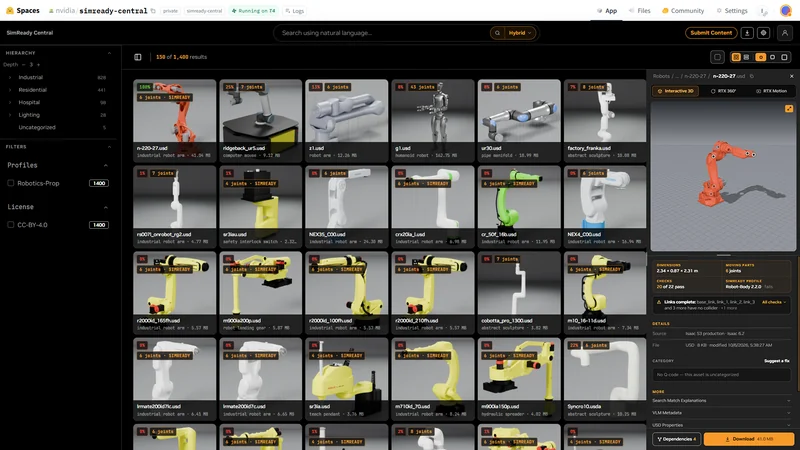
SimReady Central Launches With Over 2,000 OpenUSD Assets
Discover SimReady Central Library on Hugging Face, offering over 2,000 free OpenUSD assets for robotics simulations and AI factory digital twins.
AI Transforms Semiconductor Fabs, Accelerating Engineering Work
Discover how AI-defined fabs use accelerated simulation, physics-based models, and digital twins to speed up semiconductor manufacturing processes.