
Cloudflare Rebuilds Containers to Scale Agent Sandboxes
Cloudflare has updated its Containers infrastructure to support dynamic agent workloads, enabling runtime image and instance selection controlled via Durable Objects.
 Radwan AbdulhadiEditor and technology writer

Rearchitecting Infrastructure for AI Agents
Cloudflare has announced a major bottom-up redesign of its Cloudflare Containers infrastructure to better optimize for AI agent workloads. Unlike traditional application deployments that require predefined configurations and rollouts, AI agents create sandboxes on demand for individual tasks, expecting them to start immediately while supporting pause and resume capabilities.
Through a new scheduling policy and redesigned runtime environment, median startup speeds have dropped significantly. According to independent benchmarks from ComputeSDK, median startup fell from over four seconds down to 648 milliseconds, while preliminary internal testing successfully provisioned hundreds of thousands of containers in seconds.
Runtime Configuration and Durable Objects
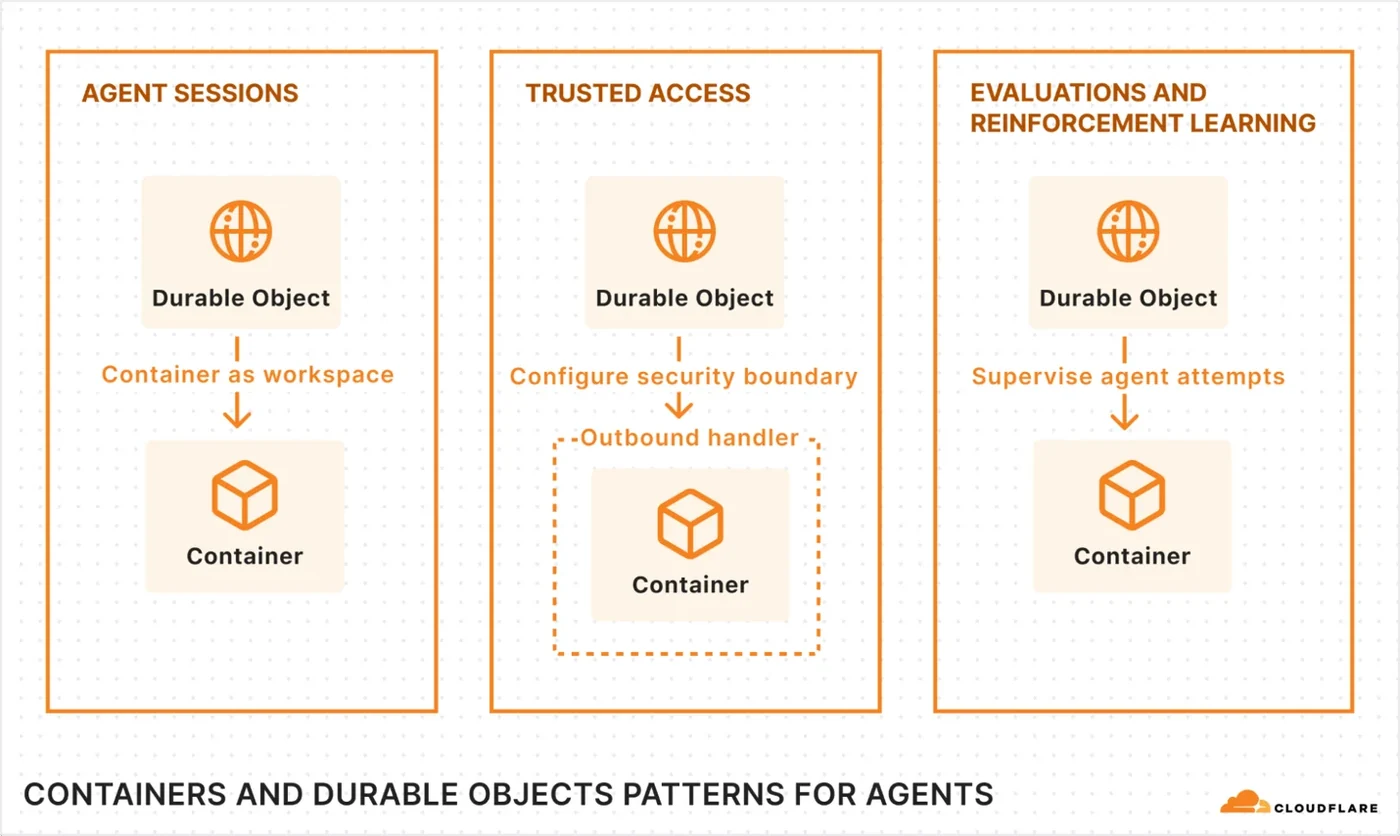
Every Cloudflare Container is attached to a persistent, programmable controller known as a Durable Object, which manages its lifecycle and outbound traffic right next to the instance. The platform is expanding these capabilities directly into the native ctx.container API and carrying the model into Sandbox SDK 1.0.
Previously, developers had to lock in container images and compute resources ahead of time during the deployment phase, requiring separate applications and routing logic to handle different workloads like Node.js or Python. The newly introduced durable_object scheduling policy removes this restriction entirely by allowing application code to pass the desired image and instance type as arguments when the sandbox starts.
Filesystem Snapshots and Workload Persistence
Along with dynamic runtime provisioning, Cloudflare has introduced filesystem snapshots in public beta. This feature addresses the requirements of longer-running tasks, evaluation frameworks, and reinforcement learning environments where preserving files produced by an agent is critical for continuing work later.
These architectural enhancements complement existing integrations across various platforms. The infrastructure update supports deployments utilized by development tools and agent systems such as Cursor Cloud Agents and Devin Outposts, providing isolated workspaces equipped with necessary repositories and development tools.
Eliminating Deployment Complexities for Rollouts
By shifting image and resource decisions to runtime execution, the update eliminates traditional rollout configurations and traffic draining procedures. Containers can continue running their initial images until explicitly stopped by application code, allowing developers to implement custom rollout strategies directly through code logic rather than centralized platform APIs.
Partners and platforms building agent infrastructure have noted the practical impact of these updates. Companies like Base44 and Kilo Code utilize Cloudflare Containers to spin up isolated development environments on demand, enabling AI assistants to execute commands, install dependencies, and manage live previews securely.
Sources
- Cloudflare BlogCloudflare Containers, rebuilt to scale agent sandboxes