
Manchester Uses NVIDIA Earth-2 to Forecast UK Pollution
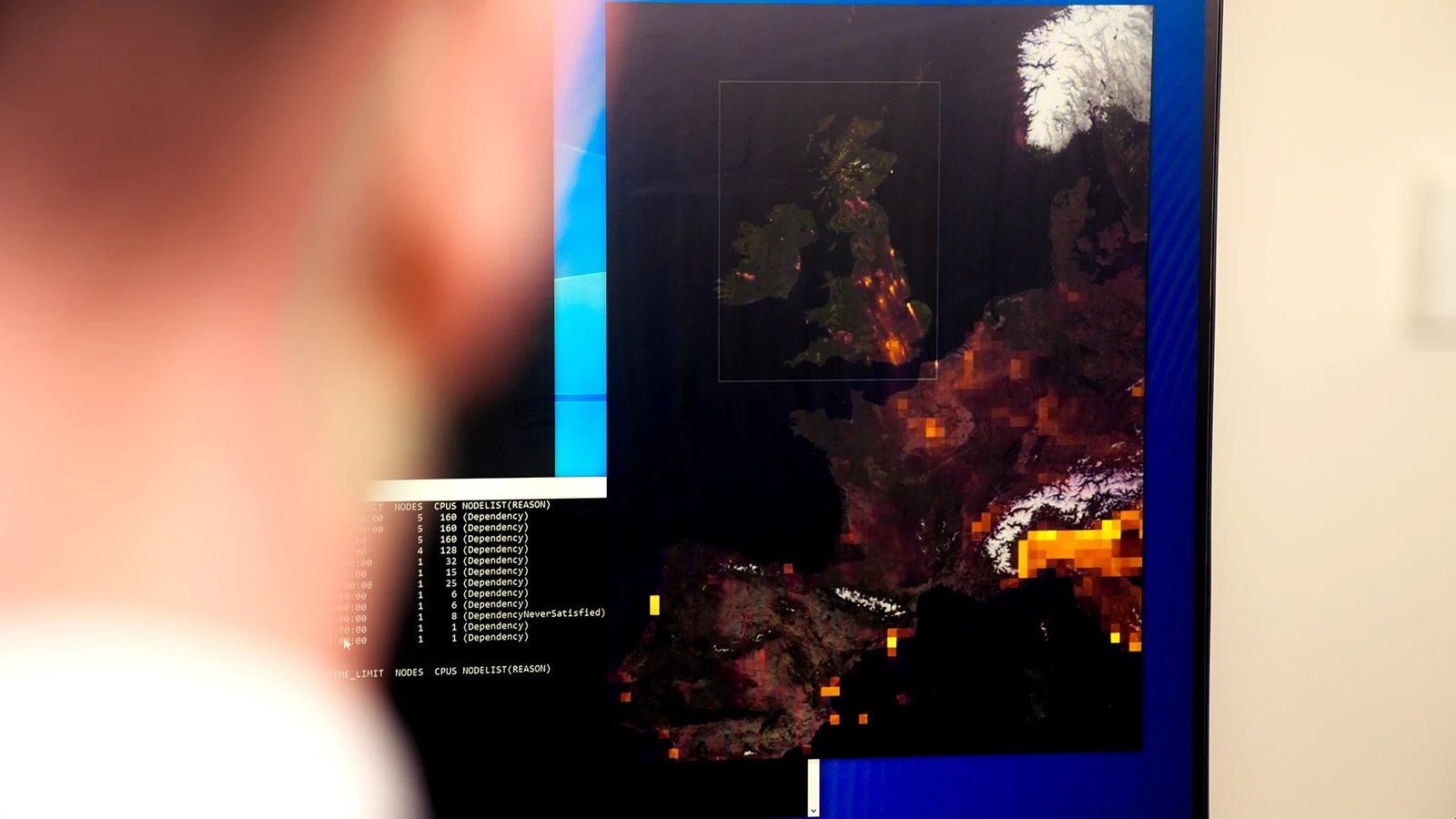
Researchers at the University of Manchester are using NVIDIA Earth-2 generative AI models to build detailed air pollution forecasts across the UK. The workflow is designed to make pollution modelling faster, more detailed and easier to run.
 Radwan AbdulhadiEditor and technology writer
A faster approach to air quality forecasting
Air pollution is a major public health risk, and the NVIDIA Blog says it contributed to an estimated 30,000 deaths in the UK alone last year. Understanding where pollution levels may rise can help public agencies and healthcare organisations respond, but conventional chemistry-based air quality models are expensive to run. Their computational demands can limit both the detail of forecasts and how frequently they are produced.
David Topping, a professor in the University of Manchester’s department of Earth and environmental science, proposed applying generative AI methods developed for weather and climate modelling to pollution fields. Working with NVIDIA’s Earth-2 team, Topping and his colleagues used existing chemistry-climate simulations to produce training data for an air pollution model.
Training Earth-2 for UK pollution data
The researchers retrained NVIDIA Earth-2 CorrDiff, a generative downscaling model, for air pollution forecasting. They used one year of UK pollution data simulated at hourly intervals to generate a detailed model covering the country at a resolution of 2-3 square kilometres.
Training was carried out on Isambard-AI, the UK’s national AI supercomputer in Bristol. According to NVIDIA, the process took two days on a single eight-GPU node. Isambard-AI contains 5,448 NVIDIA GH200 Grace Hopper Superchips and delivers 21 exaflops of AI performance.
The project’s results also demonstrate that the workflow does not depend exclusively on a large national supercomputer. NVIDIA says the same generative pollution workflow can run on its DGX Spark desktop AI system, which is powered by the GB10 Grace Blackwell superchip, for inference and smaller training runs.
Adding time-dependent forecasts
The team has since added NVIDIA Earth-2 StormCast, a model that enables time-dependent forecasts and can directly use air quality observations. Hao Zhang, a doctoral student at the University of Manchester, trained StormCast on Isambard-AI, while test-training and inference workflows were demonstrated on a DGX Spark system.
The model can provide a view of pollution over the previous year and help researchers examine possible future scenarios. Topping said the UK-wide model could be used to assess what might happen if different pollution-related government policies were introduced. The researchers are also exploring the use of additional open data to increase the model’s resolution and eventually support analysis at street scale.
Potential public health applications
The researchers see possible applications in healthcare, particularly for proactive warnings. Topping described a scenario in which regional or national healthcare services could notify people with conditions such as asthma when air pollution is expected to be high in their area the following day or week.
The team is also investigating whether the pollution model could work with edge AI devices that provide real-time air quality data. Such a connection could support real-time decisions during events including wildfires, although the source does not describe a deployed system or operational service.
Niall Robinson, NVIDIA’s developer relations manager for weather and climate, said the ability to train the model in two days on Isambard-AI and run it on a desktop DGX Spark system could broaden access to this type of research. Simon McIntosh-Smith of the Bristol Centre for Supercomputing said the Earth-2 CorrDiff workload made efficient use of the hardware and required relatively few GPU hours.
Plans for open workflows
The University of Manchester team plans to release open-source training data and workflows for its pollution models. The stated goal is to allow researchers in other countries and cities to train similar systems using local data, with a limited period of access to AI supercomputing resources.
Topping said the long-term vision is a simpler interface in which a clinician or government agency could ask what pollution will be like in a particular neighbourhood and receive an answer through a chain of models grounded in the underlying scientific frameworks. That future depends on broader access to air quality observations and further development of the modelling workflow.
For now, the project represents an application of NVIDIA’s open Earth-2 models beyond weather forecasting. The researchers are continuing to test how CorrDiff, StormCast, local observations and desktop AI hardware can be combined to produce faster and more detailed pollution information for the UK and, potentially, other regions.
Sources
- NVIDIA BlogUniversity of Manchester Uses NVIDIA Earth-2 to Forecast Air Pollution Across the UK