Discover Tools at Runtime with AWS Agent Registry
Scaling artificial intelligence agent catalogs beyond a handful of hardcoded tools often creates architectural bottlenecks. A new approach uses AWS Agent Registry to enable runtime capability discovery through semantic search.
 Radwan AbdulhadiEditor and technology writer
The Scaling Challenge of Hardcoded Tools
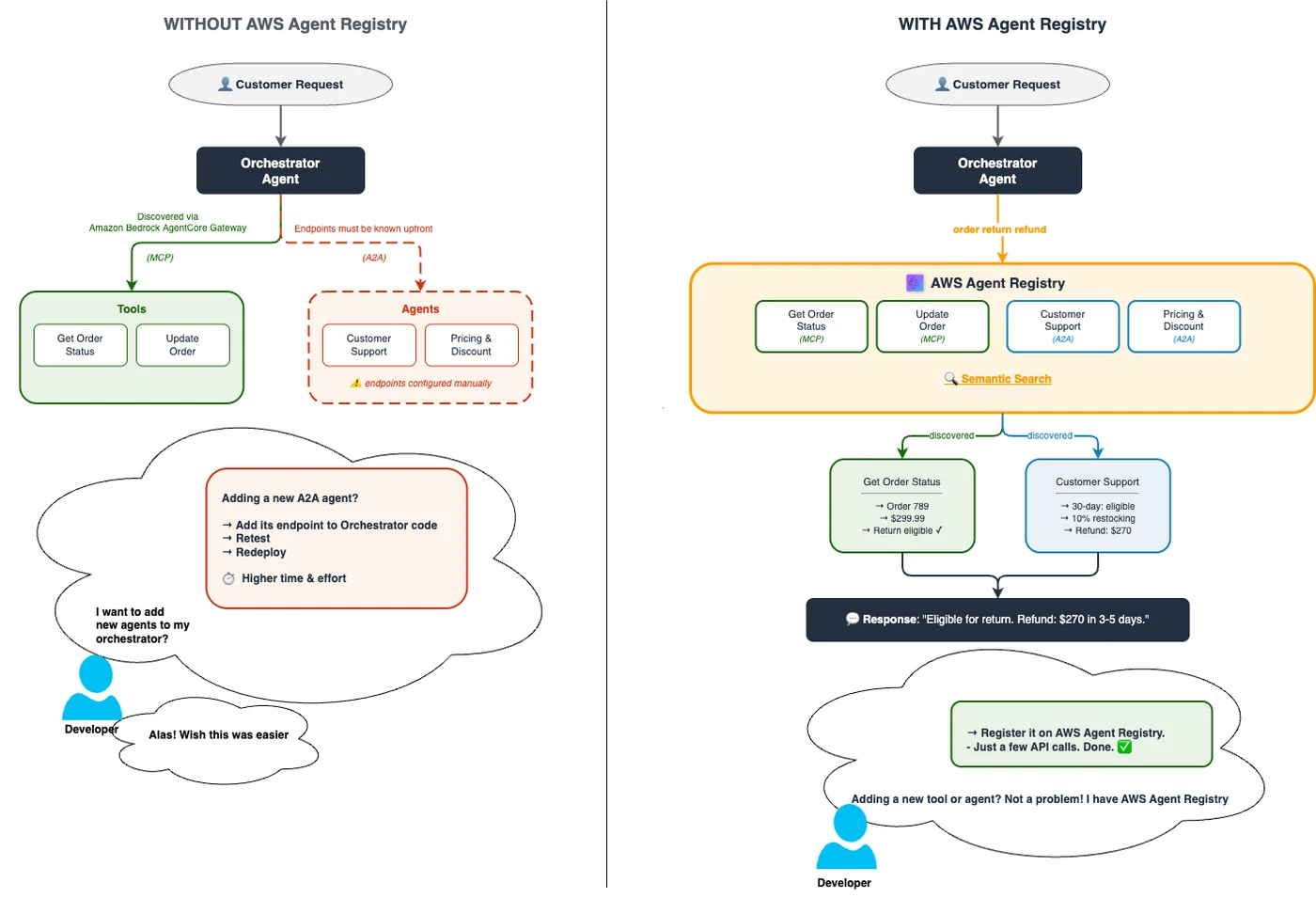
Enterprise systems frequently expose hundreds of internal APIs spanning pricing, support, orders, inventory, and customer data. In these environments, hardcoded tool wiring works adequately for a handful of capabilities, but begins to degrade at a few dozen and becomes entirely unmanageable beyond that scale. When every new capability requires code changes in the orchestrator, redeployments, and coordinated releases across multiple teams, build-time compilation turns into a severe operational bottleneck. To address this friction, developers can utilize tools like the AWS Agent Registry to switch from static compilation to dynamic runtime discovery.
The Discover, Instantiate, and Execute Architecture
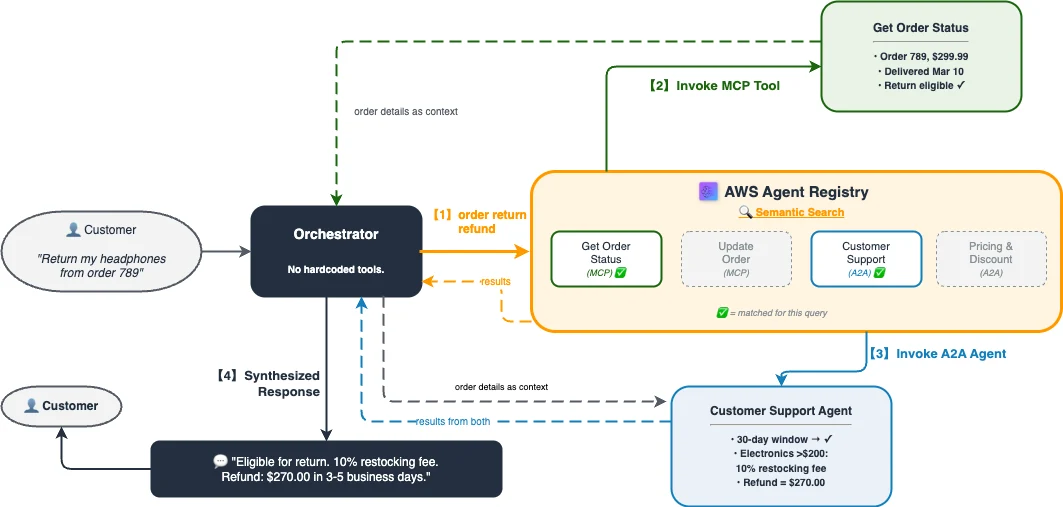
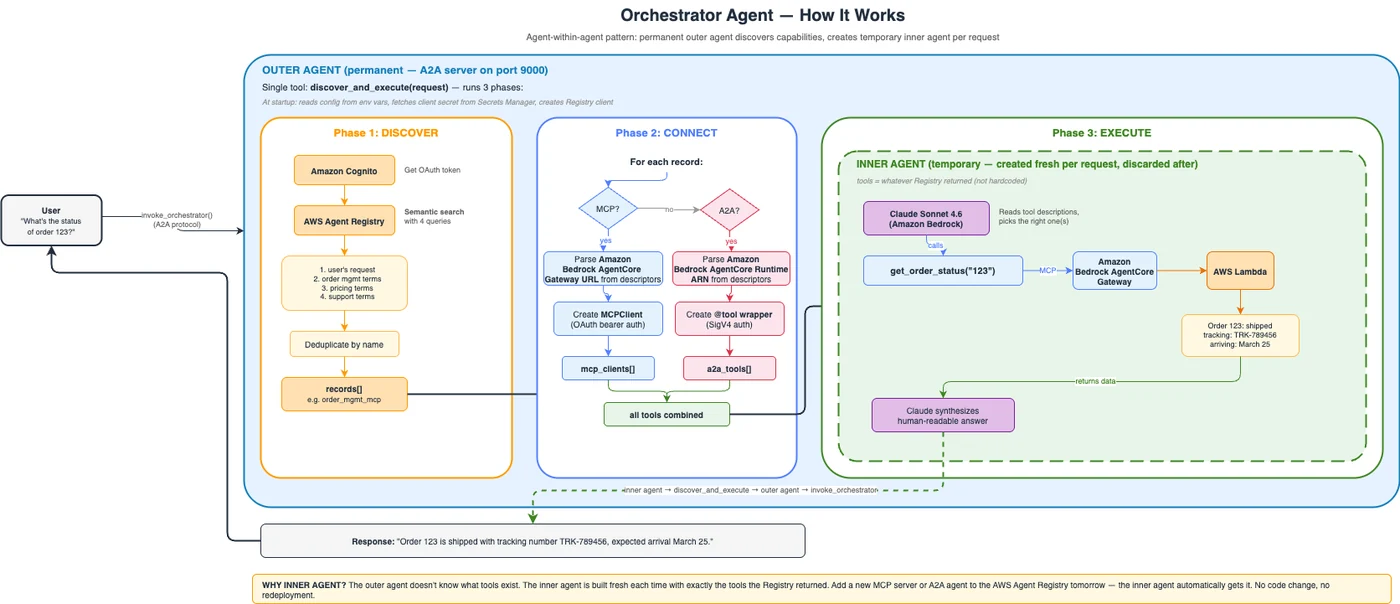
To bypass the limitations of traditional build-time wiring, systems can adopt a continuous loop where an orchestrator discovers, instantiates, and executes tools on demand. Rather than compiling every tool directly into the agent, the orchestrator queries a managed catalog to find relevant services using semantic search at runtime. This model separates the discovery phase from invocation credentials, ensuring that registry search results return endpoint identities and descriptor contents without exposing sensitive authentication material.
Integrating Gateway and Runtime Components
A comprehensive reference implementation relies on several integrated cloud services to manage traffic securely. For example, developers can deploy order-management Model Context Protocol servers through the Amazon Bedrock AgentCore Gateway, which exposes internal tools effectively. Simultaneously, agent-to-agent architectures can leverage the AgentCore runtime to host specialized workers, while the broader orchestrator logic coordinates interactions across the system.
Managing Authentication and Secure Execution
Security is a core design consideration when retrieving endpoints dynamically. While the AWS Agent Registry supplies essential connection metadata and protocol descriptors, it intentionally excludes invocation credentials and authorization tokens. Applications must independently acquire and apply appropriate credentials, such as tokens from Cognito OAuth or authorization structures handled by boto3, through trusted configuration pathways before executing requests against discovered targets.
Practical Implementation and Sample Scenarios
Developers wishing to test this architectural pattern can explore a dedicated sample directory containing complete deployment scripts, orchestrator implementations, and cleanup utilities. The provided code runs multiple demo scenarios, ranging from single Model Context Protocol calls for order status to complex chains involving pricing rules and semantic matching against ambiguous user intents.
Sources
- AWS Machine Learning BlogDiscover tools at runtime with AWS Agent Registry
Continue chronologically

Related entity coverage
Related stories
AWS and Keyfactor Detail X.509 PKI AI Agent Security
Discover how a reference architecture from AWS and Keyfactor uses X.509 PKI and EJBCA to secure multi-agent AI identity and prevent request forgery.
AWS Details Multi-Account AI Agents with AgentCore and MCP
Learn how to build multi-account AI architectures using Amazon Bedrock AgentCore Gateway, MCP, and IAM for secure cross-account data queries.
Workflow context for AI agents with Smartsheet MCP on AWS
Discover how the Smartsheet Model Context Protocol Server lets AI agents read, update, and act on live project data via Amazon Quick and Kiro.
MoEngage Integrates 400 APIs With AgentCore Gateway
Discover how MoEngage scaled agentic workflows by converting 400 private REST APIs into secure tools using Amazon Bedrock AgentCore Gateway.