Amazon Launches SageMaker AI Serverless Training Sessions
Amazon SageMaker AI has expanded its serverless model customization capabilities with the general availability of training sessions, allowing developers to handle post-training loops without managing GPU infrastructure.
 Radwan AbdulhadiEditor and technology writer
Expanding Serverless Model Customization
Companies seeking precise results from artificial intelligence are increasingly utilizing foundation models off the shelf alongside custom open-weight alternatives through post-training techniques such as reinforcement learning. Training a model on specific business context, product catalogs, or specialized vocabularies yields higher accuracy and lower operational costs. However, managing infrastructure, selecting appropriate techniques, and building environments for complex tasks remains challenging. To address these hurdles, Amazon SageMaker AI serverless model customization now includes training sessions, which became generally available today as announced on the AWS Machine Learning Blog.
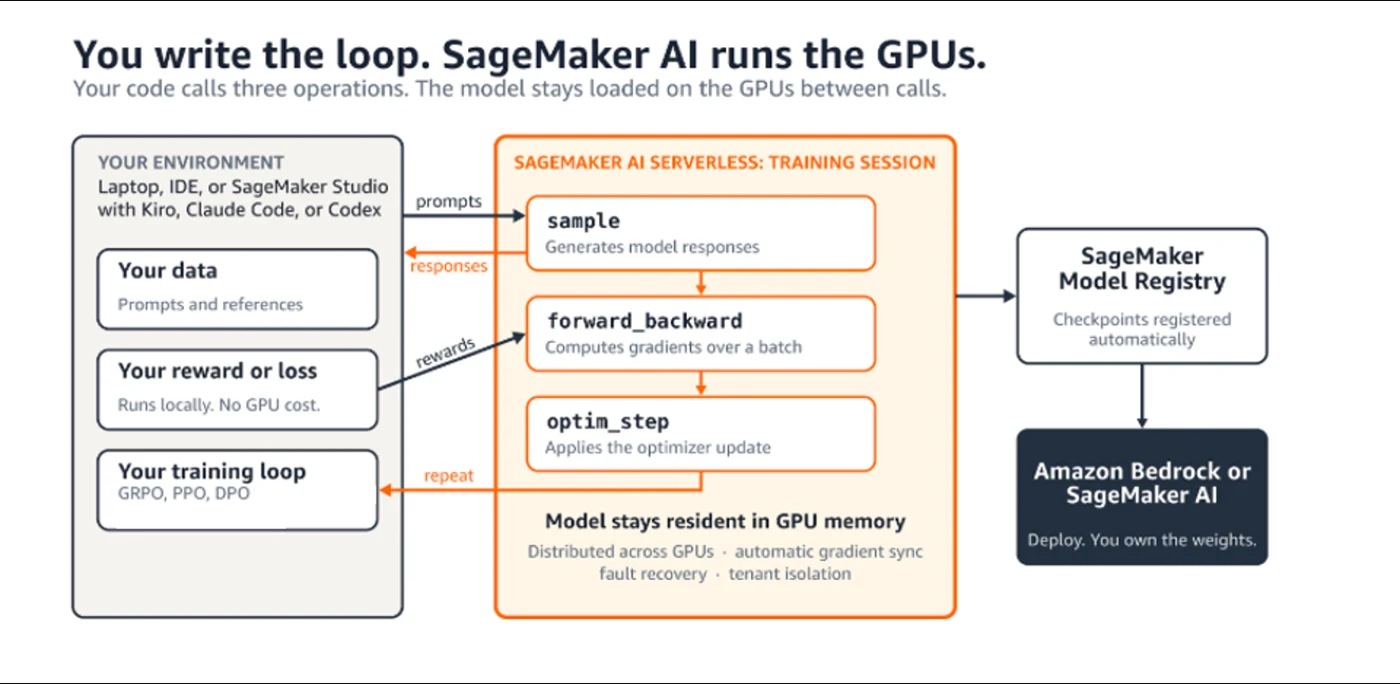
With the newly available capabilities, users gain direct control over post-training logic while avoiding the complexities of underlying infrastructure management. Developers can write and coordinate their own training loops, including custom loss functions and reward signals, while SageMaker AI handles GPU allocation, distributed execution, fault recovery, and checkpoint storage. Further details are available from Artificial Intelligence in the original source material.
Infrastructure Management and Flexibility
The platform's serverless architecture eliminates the need for users to choose instance types, manage clusters, or write distributed training configurations. Developers retain the freedom to apply a wide array of techniques, including SFT, DPO, RLVR, RLAIF, or multi-turn reinforcement learning. Furthermore, teams can choose whether to apply Low-Rank Adaptation (LoRA) or full fine-tuning, as well as chain techniques together through continuous customization.
To streamline development, the platform provides resources to guide engineers through various use cases. Detailed workflows, agent skills, and architectural examples are available for technical teams exploring advanced implementations. More information can be found in the comprehensive technical documentation and community guides.
Industry Adoption and Multi-Turn Reinforcement Learning
Early adopters have already begun leveraging the new features for demanding use cases. ImagineSoftware adopted the serverless capabilities to build a healthcare claim-denial triage model. Rob Gontarek, Senior Vice President of Data Science at ImagineSoftware, noted that the low-level API surface and direct control over forward and backward passes gave their scientists the fine-grained control needed to pursue reinforcement learning on an accuracy-critical application.
Another prominent shift in agent training involves multi-turn reinforcement learning, where tasks such as booking travel, triaging support tickets, or conducting research require multiple rounds of interaction before a final outcome is evaluated. Training sessions offer the flexibility to define custom loss functions, shape reward signals, and manage reinforcement learning stages within a single unified loop.
Implementation and Technical Workflow
In a standard training loop utilizing Group Relative Policy Optimization (GRPO), the process involves sampling responses from the current model, scoring them via a reward function or verifier, updating weights using calculated gradients, and refreshing the sampler. Developers can explore practical patterns and code structures to implement these loops effectively.
Users pay exclusively for the tokens processed by SageMaker AI, with the meter pausing while reward functions score batches externally. Data governance is maintained by keeping data and checkpoints within the user's chosen Amazon S3 buckets and AWS Region, secured via IAM roles, KMS keys, and VPC configurations.
Getting Started and Supported Models
The new training sessions support several prominent open-weight architectures, including gpt-oss-20b, gemma-4-31B-it, Qwen3.6-27B, and Qwen3.8-27B. Developers can begin working within their preferred IDE by installing the SageMaker Python SDK and utilizing available development resources.
Additionally, engineers can utilize ready-to-use environments in SageMaker Studio, connect coding assistants like Kiro, Claude Code, Codex, or GitHub Copilot, and access shared implementation patterns to accelerate their model customization workflows.
Sources
- AWS Machine Learning BlogAnnouncing new ways to customize models with SageMaker AI, without managing GPUs
Continue chronologically
Related entity coverage
Related stories
Training AI Agents with Multi-Turn Reinforcement Learning
Explore Multi-Turn Reinforcement Learning on Amazon SageMaker AI using a Wordle hands-on guide to train models on multi-step task outcomes.
Stream Low-Latency Speech With Kokoro TTS on Amazon SageMaker AI
Learn how to stream low-latency speech from AI voice agents using the Kokoro-82M text-to-speech model hosted on Amazon SageMaker AI.
Amazon SageMaker Introduces Training Session APIs for LLMs
Amazon SageMaker AI expands serverless model customization with new training session APIs, allowing custom LLM training loops without GPU management.
AWS Announces SOCI-Indexed Images for Faster SageMaker AI
Amazon Web Services introduces Seekable OCI indexing for Amazon SageMaker AI jobs, cutting container image download times from minutes to seconds.